I agree that the Carrick loop is not a bowline, (1), but only because it does not have a proper collar, not because it does not have a proper nipping loop ! Could you, please, elaborate a little more on your statement above ? Could you also provide some pictures of a tightened Carrick loop, where we can see if we do have a nipping loop or not ?
What happened to the maxim that if part of the knot IS a <particular_knot>
then it must remain so with the addition of other parts? #1033 can
have a turNip just as does the bowline , and certainly has “at least
one…collar” (oh, dear, I omitted the weasel-word “proper”, didn’t I?)
–in fact, one can see two collars, in the loose form (which has no
crossing-knot/Munter base).
How does one know when the knot’s “finished” ?
–might depend upon one’s goals for it. But you followed
the bait into the classification problem for this knot, to our
minds (not X’s, who sees a broader concept of “nipping loop”) :
the geometric form that we’d like to base classification on is
variable with tying, and perhaps with loading of some knots
set towards the boundary area between distinct forms.
.:. I think we just shrug and acknowledge this problematic aspect,
rather than make contortions to definitions in an attempt to deal with it.
(Btw, as the carrick bend provides a better form for an eyeknot,
I don’t like Ashley’s use of the name here.)
–dl*
IMO both the simple nipping loop and the bight collar must be present in the bowline description. I exclude the Karash from the bowline family because it also has this munter structure(which you call a “worsened” nipping loop). I submit to you that it has an “improved” nipping component due to the mechanical advantage of turning around it’s S.Part(though there may be exceptions due to friction). This difference justifies a separate classification apart from the more simple nipping loop structure.
Could you also provide some pictures of a tightened Carrick loop, where we can see if we do have a [i]nipping loop[/i] or not ?I'm sure that you know what it looks like xarax. If you feel that others need photos; you're so much better at that than I am.
alpineer
P.S. I don’t expect you to do my “dirty work” re pictures, just that I am too busy doing other things, one of them being a post on a new method for tying the… coming soon.
Yes, I would agree.
But you followed the bait into the classification problem for this knotMay I have some condiments with that bait, please. ;D
alpineer
Last time I checked in the ABoK, ABoK#1033 could have had one, at least, “proper” collar, but it did not ! I do not believe that Ashley re-edited his book so soon !  In case you have not noticed it, ABoK#1033, variation DL, with a “proper” collar, is an already known knot, and it is called “bowline”.
We have four distinct strategies : The first is to have a broader concept of the collar, like you do, and the second is to have a broader concept of the nipping loop, like I do. The third is to have both, and the fourth is to have none of them… I will not hesitate to adopt the one or the other, or both, or none, provided this help us study better the knots we already know, and the knots we are going to learn, if we adopt any one of the those four strategies.
I really do not know, I can not tell, we have to measure it !Here is the simple common nipping loop, and here is the twisted nipping loop, or crossing knot. Who is going to test those things ? I would also like the Pretzel nipping loop, and the Clove nipping loop, and the Constrictor/Transom nipping loop to be tested…but I do not see any volonteers around.
( The above mentioned effect, if it really esists, it is not a mechanical advantage in the sense of pulleys, it might be in the sense of levels).
While I accept that knots made by the same basic methods (such as collapsing a slipped OH or a constrictor) are likely to contain the same or similar components, I am afraid that I cannot support the concept that the tying method in any way defines a knot.
In support of this position, take the example of a knot which can be constructed by a number of different methods - rabbit round the tree - climbers twist and wrap - one handed - Inkies wrap and twist - slipped OH - etc. If I make a knot by any of these methods and give it to you for inspection, you will have no way of determining the method I had used… The finished knot is a function of its structural components and NOTHING to do with its tying method. The knot bears no witness or memory of its method of construction so we should not think of the finished knot in terms of how it was made, but in terms of what it ‘is’ and what it ‘does’.
Historically, trades passed on their knowledge through apprenticeships, and knots were taught by methods often specific to a particular trade. This history is dragging itself into our present way of thinking, but I hold that this is a wrong minded approach to understanding and categorising knots.
Derek
There has been considerable talk of defining a Bwl by its nipping loop.
OK, if anyone is more than half serious about this, try to make a Bwl without its other key component - its bight loop… then show us it in action. Only then will I concede that a Bwl has one component, not two - a simple hitch (turnip) holding and being held by a bight loop - i.e. the SBcore.
Derek
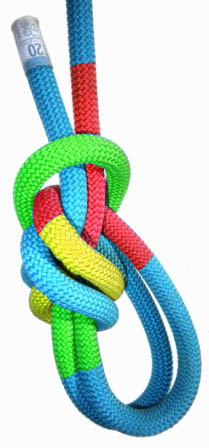
@Mark, you asked for my justification for calling the Karash a Bowline Variant.
The first image clearly shows the bight loop in green. Don’t get confused with the second (double) Karash loop, the bight loop would function just as well with one loop or two, the key is that it is a bight loop containing and bearing against and contained by - a hitch.
The second image shows the part of the knot which provides the simple hitch functionality (red) via the variant structure (a twist) in yellow.
It is a bowline by the definition I offered because it has the bight loop and the hitch, but it is a variant because it has a variant hitch.
Derek
Here are the pictures ordered by alpineer, and delivered by me…
The heavy gun of Dan Lehman does not seem like a bowline at all, I am afraid, but not because it does not have a nipping loop ! Its nipping loop is there, in every dressing of this knot. What is missing though is the collar. And, please, do not confuse the nipping loop with a collar : A structure is either a nipping loop or a collar, it can not be both of them, simultaneously ! The essence of the collar is that, when the tail passes around the standing end and returns to its nest, the tensile forces on the second leg of the collar are greatly diminished, so the tail is secured by the nipping loop s action on it very easily. If the second leg of a bight is tensioned as much as the first, we do not have a collar, we have a nipping loop . And if the second leg of a bight is not loaded at all, we do not have a nipping loop, we have a hitch.
I think that this Carrick bend (ABoK#1033) seems more like the Perfection loop / Angler s loop (ABoK#1017, #1035) than a bowline, and Angler s loop is not a bowline ! ,
Now, the ABoK#1033, in its capsized as well as in its not-capsized form, does seem to incorporate a hitch, indeed, that is, it seems to obey the theory of Derek Smith, MUCH more than the simple bowline…
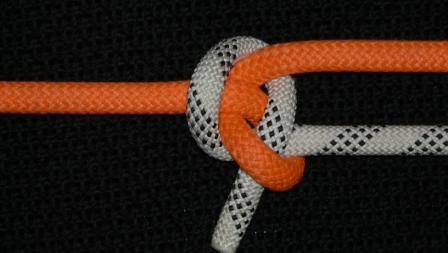
- The nipping loop is not a hitch. When a bight has both its ends loaded, and it is nipping a line that goes through it, it is a nipping loop. When a bight has only one of its ends loaded, it is a hitch. BIG, HUGE difference !
- The collar is not a hitch. A hitch has its second leg pressed under its first leg ( on some other tensioned rope strand or rigid surface). A collar has its second leg nipped by the nipping loop, and secured because of the action of the nipping loop on it ( which, after its turn around the tree, does not pull as hard as before, so the nipping loop has a much easier job to do…) The second leg been secured by the nipping loop, not by the first leg. BIG, HUGE difference !
As you might have guessed by now, my purpose is achieved : By 1) and 2), it is proved that there is no hitch present in the bowline !
If one wishes to discover a hitch, he must search for it in the Carrick bend (ABoK#1033), or in the Angler s loop (ABoK#1017, ABoK#1035). It is a lot easier for one to find a hitch there, indeed, it is only there that one can find a hitch !
I quote this text word by word because it has to be at more than one place, so it will have a much lower probability to be erased by accident, by a computer bug or something. It would be great if I had been able to write it, but it was great to read it as well.
DerekSmith, can you please apply your coloration to the following knots and therefore also apply your hypothesis for all to see?
EDIT: If I’m understanding your hypothesis correctly, the Carrick loop #1033 does not have a bight loop/collar that is fully encircled and gripped by a nipping loop. Therefore, the Carrick loop is not a Bowline. In examining the single Karash loop, it appears by my eye to have a bight loop/collar that is encircled and gripped by a nipping loop - although in this case the nipping loop is a variation due to its unusual added half twist. Now I’m try to apply your hypothesis to the Sheet bend #1431 to see where this structure belongs!
NOTE: The first image shown (#1010) is a control image.
All images courtesy of your friendly agent smith…(first 3 images taken against a white background in full natural sunlight using a flash).
Thanks, Mark
EDIT: Sheet bend added (NOTE: Photo of sheet bend taken indoors against a white backboard using 2 high intensity light sources - no flash used).
http://
http://
http://
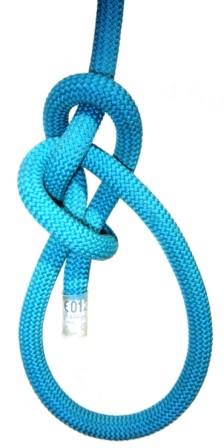
Personal preference I suppose, Mark, but I do find your images easier on the eyes.
alpineer
Your ability to force square pegs into round holes is impressive
–of stubbornness.
Just slacken the white rope’s completion of #1033 and you’ll
see not one but TWO collars appear; that should satisfy even
the most hungry bowline-seeking appetite.
(They might even appear as set, with greater forces and elastic
cordage.)
We have four distinct strategies : The first is to have a broader concept of the collar, like you do,
Rather, I don’t stipulate “collar” in my definition of “bowline”,
which you do. Maybe I see a collar where you don’t, also;
but my What is a bowline? concern is centered on the turNip
–which somehow must be pretty well stabilized (though there
are issues with deformation under load, poor/loose setting,
and so on).
Now, to Derek’s
There has been considerable talk of defining a [i]Bwl[/i] by its nipping loop.OK, if anyone is more than half serious about this, try to make a Bwl without its other key component - its bight loop… then show us it in action. Only then will I concede that a Bwl has one component, not two - a simple hitch i[/i] holding and being held by a bight loop - i.e. the SBcore.
My quick answer to this is “Myrtle eyeknot” --the turNip
otherwise secured. One can also consider the so-named Eskimo bowline
–which collars an eye leg and … <does what to?> the SPart.
The finished knot is a function of its structural components and NOTHING to do with its tying method. The knot bears no witness or memory of its method of construction so we should not think of the finished knot in terms of how it was made, but in terms of what it 'is' and what it 'does'.
For the purposes of knot classification, I’m happy with this statement;
but for the purposes of understanding the knot’s behavior, I disagree:
a knot might well “have memory” of its tying method --in torsion of parts,
e.g.. (I have been amazed to find not only one but TWO kernmantle
rope testers[f] who tested the fig.8 eyeknot as both “re-threaded/-woven”
and “on a bight” !! --as though the knot cared, as you say. BUT, IFFFF
one were to sample actual tyers of said knot --as an in-the-field research
study, hands-on data collection, one MIGHT find e.g. that different
forms of the knot (which is after all never precisely specified) obtained,
that (suppose…) when tied in-the-bight it was usually so-dressed and
this end loaded, but was otherwise when “re-woven”. Of course,
one’s test data then, if showing some difference, would be evidence
of the different forms of the knot.
Well, I’m not so happy with “what it does”, as in the case of some
(what I call) “noose hitches” what is done might depend upon the
material & force --the midshipman’s hitch not fixing an eye,
and two half-hitches being adequately called a “noose” by
structure, hitching to itself, a compound structure, not a knot
(the clove hitch finish being the knot).
[f](CMC Rope Rescue Manual and Dave Richards are the two testers
who did this, of whom I’m aware --published reports.)
–dl*
Look who is talking - of stubbornness !
Had your stubbornness, even for a moment, made you dream that I would not have thought this desperate escape route for you ? Read my lips ":
The collar is not any U turn of a segment of the rope…The collar is a U turn of the tail, it is a mechanism of the tail, a means of the tail to be secured easier by the nipping loop. The collar has both its legs going into the nipping loop from the same direction, i.e., the working end, when it enters the nipping loop - as the second leg of the collar-, is pointing to the opposite direction than the direction it has when it exits from it - as the first leg of the collar. So, the two legs of the collar are, more or less, parallel to each other.
Also, the nipping loop is not any 360 degrees turn of a segment of a rope…The nipping loop is a 360 degrees turn of the standing part around the tail, it is a constricting mechanism that nips the tail, a mechanism to secure the tail.
It is absurd to talk about collars on the standing part, and nipping loops on the working end / tail !
What you think you see on ABoK#1033, is not a collar ! It is a nipping loop on the standing part and/or a U turn of the line of the standing part.
I agree with that.
Another structure to study in detail…the Eskimo bowline. This time showing it with the control #1010.
http://
Agent Smith, I think that you follow the convention to name as the “front” view of the bowline, the view where the (first) nipping loop is shown with the standing end passing over the eye leg of the standing part. So, in order to compare two or more of the various members of the bowline family and other similar end-of-line loops, it is better, I believe, if we put side by side pictures of the front or/and the back view of the one loop, with pictures of the front or/and the back view of the other, respectably. This view of the Eskimo bowline iis the back view. ( Oh ! did I say “the” Eskimo bowline , and not “the so-called” Eskimo bowline ? Have I seen something in the Eskimo bowline where nobody else sees anything at all ? :))
Hi Mark,
I am more than a little disappointed you think so little of my abilities to appreciate functional structures, that you give me a pretty little woven decorative mat under the pretence of it being a Carrick loop.
This is typical of the situation where a knot is made using a method that is memorable, but the structure tied then has to morph/capsize into the stable working knot. It is also an example of a working knot being given a name from the method of making it - in this case, from the Carrick mat.
Calling the Carrick mat a Carrick loop is like calling a Tucked, Slipped OH (TSOH) a Bowline… the TSOH is an intermediate, memorable or easily created, but still only an intermediate - only when the intermediate is finally morphed does it become the target structural working knot.
Derek
Hi DerekSmith,
Not sure what you’re actually trying to tell me here…?
Am only the guy who is snapping photos to try to assist others (such as yourself). And, I want to understand the structure of a Bowline.
At post #49 above, I posted images of a few structures (and at #53), the ‘Carrick loop’ #1033 included (that’s what Ashley refers to it in his masterpiece). I tried to keep the dressing loose and easy to draw direct comparison to the ‘control’ structure of #1010. I was hoping you might be able to apply coloration to all the above images.
As for your abilities, I think very highly of them and have strong respect guys like you and Dan. Maybe I’m missing some British humor here…perhaps you’re joking!?
I think there is a real opportunity here for some great thinkers to make a breakthrough…I happen to have a little remaining spare time for this work - but that time is running out. Its not often in life where you get opportunities like this one where so many very knowledgeable people can direct their minds to such a complex problem. I see this time period (right now) as a narrow window of opportunity…
Anyhow, would certainly appreciate if you could continue to apply your hypothesis (and coloring) - because I think we are getting closer to a working theory of the Bowline.
Mark