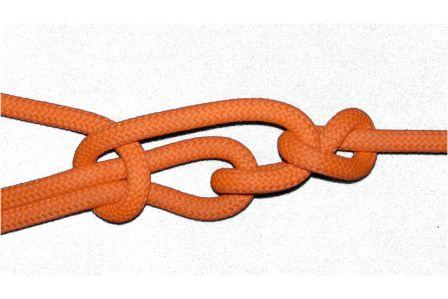
It’s not perspicuous to what you refer, except that “Carrick” occurs
only in one place, and … --inferences follow that.
What Agent_Smith shows is relatively accurate of what can obtain
from tying; and this knot structure has its turNip much like the Gleipnir’s orientation of it. (Or, if one hauls harder on the tail
in setting the knot, one gets a sort of crossing knot base, which
was the issue I let Alpineer draw out, as a classification problem.)
It seems confusion rules - OK - and there was me thinking that I was trying to help you…
But I think that your last post and Dan’s subsequent post have both helped identify what might be clouding the issue, and that is that just about everybody I know thinks of, and represents, knots in the form in which they are made. This is fine for knots that are made in virtually their final working configuration (i.e. sheetbend etc.) but for knots like the Carrick, it is a confusion that tends to lead people to think about the functioning knot while holding the Josephine Knot image in their minds eye.
While Ashley clearly made the distinction between the decorative weave - the Josephine Knot - and the functional Full Carrick Bends (#1428 and #1439), he then repeatedly falls into the trap of depicting the Carrick as it is made - i.e. as the Josephine. Only once does he depict the Carrick in its working form -
The CARRICK BEND, when under stress, pulls up into easy loops,
which may be readily opened with a few light taps from a belaying
pin, fid, or other implement. It may be water soaked indefinitely,
and even then it will not jam.
Sometimes the CARRICK BEND is illustrated with the ends both on
one side (#1428) instead of diagonally opposite, but this is not so
secure. At sea it is tied as shown here.
Lescallier gives the knot by name in 1783.
Following this example, even you have depicted the Carrick as the Josephine weave, and Dan supports this by stating that your image depicts a structure which is “accurate of what can obtain from tying;” - and this all stems from the way the knot is made - virtually nobody thinks about the way the knot WORKS. As we are dealing with practical, i.e. ‘working’, knots then we are dealing with ‘Force Machines’ whose function is utterly dependant upon their structure under load. At least Ashley accurately declared “The CARRICK BEND, when under stress, pulls up into easy loops,”. It is this ‘easy loop’ structure we need to be considering when we think about what makes a Carrick vs what makes a bowline.
Even Xarax has a penchant for depicting knots in all their beautiful ‘as tied’ symetry, as commented on by Dan “Your ability to force square pegs into round holes is impressive”, and I have to admit that until I started to pit one knot against another to destruction, I also toyed with structures devoid of loading impetus.
It was partly my work with loading knots, partly my work on attempting to develop a means to create a knot’s signature (Overs Index and Binary Signature) and partly my attempts to create a ‘Drawing Program’, that led me to the perception of key functional components. You have alread met the first two - the Bight Loop (or Bight Collar), and the Simple hitch. One of each makes the SBCore I described earlier, two ‘Bight Loops’ make the Reef square knot, while two simple hitches can make either the Granny or the Whatknot.
So now it is time to introduce you to the third component - The Carrick Component.
First make a Full Carrick (#1439) and load it to make it morph into the ‘easy loops’ working structure.
Now, without changing its structure, loosen it off slightly, and completely remove one cord while keeping the structure of the other cord firmly in place. If you paid attention to the component you removed and are able to recreate it, you will see that they are identical - they are The Carrick Component (CC).
As you have seen, this third component can be compounded to itself - the Full Carrick. It can also be compounded with either of the other two components we have so far seen - the Bight Component (BC) and the Simple Hitch Component (ShC), making three basic bends -
CC..CC- Full Carrick
CC..BC
CC..ShC
to go with the ones already seen
BC..ShC - Sheetbend
BC..BC - Square knot
ShC..ShC - Granny or Whatknot
Naturally, any of these hitches can be reconfigured as a loop knot.
As I have already proposed a definition for the Bowline - a loopknot made from BC and ShC (the SBCore). The Carrick Component is (for this discussion) a new component, therefore, no knot containing it (by the proposed definition) is a Bowline.
Derek, I do like your attempt to reduce the working of any practical knot in just a few basic elementary mechanisms. I have also attempted something like this, so I know it is mind-seducing to the point it may well hide from us an obvious fact. And the obvious fact here is that there is no sheet-hitch mechanism in the bowline…because the bowline collar is not a hitch. A hitch is defined by the asymmetry of its two legs, we can not have any hitch where the one leg is not passing over and the other is not passing under…as it happens in the sheet band. In a collar, the two legs are almost parallel to each other, as they enter and as they exit the nipping loop. I understand that you believe that the sheet bend is more elementary than the bowline, so you are trying to explain the bowline in terms of the sheet bend. I believe that both are among the simplest knots, but that they are quite different : the bowline uses the collar, which is absent in the sheet bend, and the sheet bend uses the riding turn mechanism of the hitches ( that is, the one leg of the hitch pass over and the other passes under, so that the second one s squeezed by the first), a mechanism absent in the bowline. The loops that can be explained by the sheet bend indeed, are the Carrick loop, and the Angler s loop. The bowline is a Gleipnir with a collar, nothing more, nothing else. I wonder how you would explain the Gleipnir, with the sheet band mechanism…
It is good to know that you are also attempting to identify the components of a working knot. I agree, it is all too easy to be seduced by one’s own and therefore myopic viewpoint - having access to others perspectives is critical to being able to consider flaws and weaknesses in one’s view and so work towards a stronger, less flawed, understanding.
I have taken your arguments seriously and looked again at my perception of the Simple hitch component of the Bowline, and as seems to be the case with working knots, the closer one looks, the more complex the detail becomes…
First up, let me clarify a couple of points that I believe we agree on :-
The Simple Hitch HAS to have the loaded line pinning the end against some ‘static’ surface by lateral pressure, in order to generate the anchor force which is then amplified by the turn around the ‘static’ object. [Note: on closer inspection the Simple Hitch is far from simple and can in turn be broken down into its own components]
That the Bowline CAN be configured such that the component I have called the ShC clearly has no 'hitch functionality at all and is functioning instead as a nipping turn - a la Gleipnir. [Note: in order to achieve this configuration, the bowline would be considered by many to be in the process of capsizing]
Having again looked in detail at the operational structure of the bowline I am convinced that my original assertion that this component is a ShC. I will attempt to explain the reasons for my position to you, and I think this can best be done by a working example.
First up, make a bowline. The following image from MotorboatsMonthly is I believe a good representation of what would generall be accepted as a working bowline.
The image clearly shows the SP trapping and pinning the ShC end against the twin bight legs. Proof that this is a working ShC can be demonstrated as I argued before - put 100% load across the SP and just the bight loop leg - the knot is a fully functioning Sheetbend.
But the proof does not stop there - now swing 100% load onto the ShC loop leg - the now dressed and set bowline will keep exactly the same conformance and the SP will continue to nip the ShC end tightly against the bight legs - granted, no frictional amplification is happening, because the ShC loop end is leaded to exactly the same load as the SP - but the point is, the structure is there and if the load in that leg of the loop dropped, then the component would function again as a ShC.
In reality, the loading across a bowline loop legs is rarely equal or static and for a large proportion of the time, the ShC is working to transfer load into the bight loop leg.
I present you a gift, to test your theory ( that is, to try to falsify it, as we have to do with all theories ). It is the, whimsically called, “Derek Smith 50% bowline” ( 50% refers to the loading of the eye leg of standing part and the eye leg of the bight). To my theory, it is a bowline 100%. No hitch present, legs of the collar 100% parallel to each other and to the standing end. WHERE s this SB part, where is this sheet bend hitch, or any hitch whatsoever ?
I admit that I am seduced by the Gleipnir mechanism, as you are seduced by the sheet bend mechanism. My opinion, of what is worth, is that the bowline is a closer relative to the Gleipnir, than to the Sheet bend. Your theory was valid before the advent of the Gleipnir, mine is valid afterwards…
Well, first up, I did not propose a theory - I offered a definition of a bowline in functional component terms - that is, the Bowline is a loopknot based on the SBCore. In turn, the SBCore is a compound structure made from two components, each containing and contained by the other, those components being the Bight Component (BC) and the Simple Hitch Component (ShC).
However, to falsify this definition, all we would need to do would be to take a knot which was self evidently a Bowline and test it with the definition to see if it successfully identified the knot as the Bowline.
In the case of the delightful whimsy you have proposed as a test piece -
Does it contain the BC – YES
Does it contain the ShC – NO - it contains instead the Half Hitch Component (HhC)
Do these components contain and are they contained by each other – NO
Conclusion - by the offered definition, the whimsy is NOT a Bowline (nor do the additional components confer the status of Bowline Variant)
Does this falsify the proposed definition - well, yes it would IF the proposed test piece were self evidently a Bowline. One test for that might be - would the ‘man in the street’ identify it as a bowline? I would suggest that most people would not, so we have failed to falsify my proposed definition with this test piece…
However, the subject of this post is “What defines a Bowline”, so we have to come back to ask the question - “By what definition do you claim this to be a Bowline ?”
NB - as a whimsy, this construction is a doozer, but as a practical knot it falls apart the moment loop leg tension shifts even slightly from its defined 50%. So as Bowlines are supposed to be the proverbial ‘King of (practical) Knots’, this little whimsy would have have quite a fight on its hands to be able to qualify…
By the definition given in (1), and quoted by agent smith at the first post of this thread ! I will repeat it, in a slightly different wording :
There are three, and only three elements that characterize a bowline, in relation to any other end of line loop:
The knot tied on the standing part s leg, should be topologically equivalent to the unknot, i.e., it could be completely untied with the removal of the rope segment after the eye leg of the bight. Any sailor will laugh with an end of line loop that is not completely untied like the bowline.
This knot on the standing part should include one, at least, nipping loop, which secures the tail.
The rope segment after the eye leg of the bight should include one, at least, collar.
Based on that definition, the “bowline” presented above IS a bowline indeed ! ( Of course, following Dan Lehman, I have twisted the meaning of “collar” a little bit :), as the U turn of the tail is around the standing part, indeed, but there is something else in between the nipping loop and the touching point of this “collar” with the standing part…I offered this example to you as an easy target, but you failed to shoot where you should, to the " Dan Lehman collar"… :))
My point was not answered from you, not now, not any time before. A hitch has its two legs highly asymmetrical, in looks as well as in function. The one is squeezing the other, so the one crosses the other, it passes above the other. The collar has its two legs symmetrical and parallel, they touch each other, of course, into the nipping loop, but they do not have to cross each other ! The two legs are squeezed by the nipping loop, they are symmetrical, in looks as well as in function. You want so much to explain the bowline in terms of the sheet bend, that you try to see the sheet bend hitch part in the bowline, too…Well. there is not such a structure there, and that s evident in the case of the bowline closest relative, the Gleipnir.
This test piece was an example of how a bowline structure can work, with the two legs of the collar parallel to each other and to the standing end. If it is not a bowline, it is not because the nipping loop does not hold as it holds in the case of the Gleipnir, i.e. with parallel legs going through it. It is because there is another structure, intervening between the “collar” and the nipping loop. You are right, of course, that most men in the street and the harbours will not identify this lousy loop as a bowline, but the only thing that this proves is that we should define the collar even more strictly - and not even more loosely, as Dan Lehman does ( and, as a result of this, he is driven to the indefensible position that the Carrick loop and the Angler s loop are bowlines…)
So, yes, let us define the collar in a way that does not include the collar-like stricture of this loop, to be in accordance with the tradition of the men in the streets and the harbours. But we must not confuse it with the hitch that exists in the sheet bend structure, because they are two completely different things. They are both very simple, elementary structures, so we have to be very careful to avoid any confusion between them, because if there is a confusion here, it goes all up to the top of the ladder, and we would not be able to analyse correctly the more complex knot structures.
My quick answer to this is “Myrtle eyeknot” --the turNip
otherwise secured. One can also consider the so-named Eskimo bowline
–which collars an eye leg and … <does what to?> the SPart.
What do you say to (how do you classify…) this (these)?
and ABoK 160 and 161 - - the very epitome of the ‘Turn-nip’.
and…
Hoever, the exercise of pointing me at the Half hitch Component (HhC) has been fruitful, as it has had me thinking at the subtle, yet significant, differences between the ShC and the HhC.
The ShC has an unloaded end which is trapped by the loaded part against some other component, while in the HhC both parts are loaded and they bear against each other before turning into the nipping loop.
This then makes the component at issue within the Bowline a component which changes between a ShC and a HhC, due to the transient loading from 0% to !00% dependent upon the swing of the load / loop / SP. However, unless wrongly tied, it is almost never a true HhC, and when correctly dressed, it is more correctly a ShC with partial end loading.
The Eskimo Bowline however, is an altogether different machine and I am going to think on it’s components some more. Anyone with thoughts, please dip in - more hands (minds) make light work.
Derek, with all respect, you are confused about this matter !
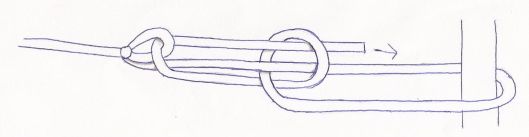
Fig 39 shows a hitch, indeed, because the “two legs are highly asymmetrical, in looks as well as in function.” The one leg is over the other,“it is squeezing the other, so the one crosses the other, it passes above the other.” This is the elementary mechanism of “the riding turn”. The riding turn is one of the five basic elements that we meet in practical knots.
In your second and third picture, you do not specify if the free end is loaded or not. If it is NOT loaded, we have half hitches indeed, because “When a bight has only one of its ends loaded, it is a hitch.” Now, if those legs ARE loaded as well as the others, ( i.e., both free ends of the knots are loaded ), the part of the knot you think it is hitch, it is not : it has both its legs loaded, so it is a nipping loop.
In ABoK#160 and #161, as well as in the test “bowline” I have submitted to you, and every bowline everywhere in the universe, we do not have hitches, we have nipping loops. Plain and simple ! I now understand how one can be blinded, even if he has the best intentions, as you do ! Read my lips :
Derek, please, do me a favour : Try to listen to me for one f…sentence ! The blue part you show is a nipping loop, not a hitch, because its two legs are both equally loaded, and they are symmetrical, in looks as well as in function.
The transient type of “hitch” you mention, the “Hhc”, is not a hitch ! It is a nipping loop, where the legs, after they meet, they are in an elbow configuration to each other. So, the plane that is defined by the two legs of the nipping loop, just after they meet and leave, each towards another direction, is at an angle with the plane defined by the bight of the nipping loop.
I can understand a distinction beteen nipping loops, where this happens, and nipping loops where this does not happen.
So we have nipping loops where
the free ends of the loaded bight leave the loop without been bent around each other, i.e. they leave, but remain in the plane defined by the bight,
and nipping loops where
the free ends are crossed, they are in an elbow configuration with each other, they leave the loop after they are bent around each other, so they do not remain in the plane defined by the bight, but part to different directions.
This distinction is between two kinds of nipping loops, where both legs are equally loaded, not between a hitch and a nipping loop !
Um, before doing that,
please answer my response to your challenge
about tying "a bowline" without the bight.
I’d like to advance on this issue (i.e., have definite
thoughts).
[b][i]The blue part you show is a nipping loop, not a [u]hitch[/u],
because its two legs are both equally loaded,
and they are symmetrical, in looks as well as in function.[/i][/b]
X., in general, you don’t require “equally” (which of course
it isn’t, in the base knot) --just a note here about the point.
Frankly, I do not regard this structure AS A KNOT
–RATHER, it’s a compound knotted structure.
Let us ignore, for a moment, the capstan effect on the collar bight U-turning around the standing part. Then, the two legs of the collar would be equally loaded, because it would have been as if we had a freely revolving pulley on the standing part, so no friction at all between the standing part and the collar. Now, consider that the nipping loop can move freely (walk) alongside the standing part, while keeping the two legs of the collar glued together, independently of its particular position. Will this nipping loop move (walk) alongside the standing part by its own, when the whole system is loaded and brought to an equilibrium ? Nooo. So, the two legs of the nipping loop are equally loaded, otherwise it would move towards the direction of the stronger pull.
If the trucker s hitch is not a knot, but a compound knotted structure, then yes, “I” agree.
I have thought of this artificially conceived “loop” only as a way to show that :
the two legs of a collar can be almost parallel to the standing end, and to each other. This is happening in the case of the bowline and the Gleipnir. On the contrary, this is not happening, and can not happen, in the case of the Sheet band hitch mechanism, or any hitch whatsoever. So, the collar of the bowline can not be considered as a hitch. In the Sheet bend, we see segments of rope strands perpendicular to each other. On the contrary, in the Gleipnir or the bowline, we see only segments of ropes that are almost parallel to each other. As I have said, “In a bowline, none of the two legs of the collar are in a right angle with a segment of the standing part, as it happens with the Sheet bend ! In fact, they are almost parallel with it, at the proximity of the nipping loop…” “A hitch is defined by the asymmetry of its two legs : we can not have any hitch where the one leg is not passing over and the other is not passing under…as it happens in the sheet band. In a collar, the two legs are almost parallel to each other, as they enter and as they exit the nipping loop.”
So, the bowline is a relative to the Gleipnir, not to the Sheet bend.
the nipping loop of this 'loop" can be far away from the point where the collar touches the standing end, i.e. the U-turning point of the first leg of the collar around the standing end. This can not happen in the case of the Sheet bend hitch mechanism. So, the hitch mechanism of the Sheet bend can not be considered as a nipping loop, like the one we have in this “loop”. And, because the nipping loop of this “loop” is just like the nipping loop we have in the bowline, the nipping loop of the bowline can not be considered as a Sheet bend hitch mechanism.
3 . the inclination of the plane of the nipping bight in the picture of the bowline, provided by Derel Smith in reply #60, is misleading. A bowline holds even if its collar is loose, and the U-turning point of the first leg of the collar is not very close to the nipping loop. In that case, the inclination of the bight of the bowline resembles the inclination of the bight of the test “loop”, ( the “blue” segment). Both loops are nipping loops, and their nipping action is not depending on the specific inclination of the plane of the bight. Of course, as a nipping loop is more “twisted”, its nipping power is diminished, because it is wasted by friction around the crossing point of its two legs. So, the less the inclination, the more the nipping power of the nipping loop on the two legs of the collar that pass through it. But this does not mean that the inclination is a necessary or a contributing factor to the nipping action, it is only a detrimental factor on a nipping action that already exists, because of the fact that both legs of the bight are loaded.. So, the inclination in the picture provided by Derek Smith, that forces the eye to be at a right angle / perpendicular to the standing part, is not a nessesary condition for the nipping action of the nipping loop. That inclination might have been the cause that misled Derek Smith in thinking that the nipping loop of the test “loop” is a hitch, when it is clarly a nipping loop, just like the nipping loop of the common bowline.
To be clear : I’m referring to the common bowline (#1010).
I’m not sure what you’re saying here, but in actual physical terms,
the load on the eye legs --on either-- is 50% (roughly) which is
half of the 100% on the SPart; thus, the turNip is UNequally loaded
in its circle (just as in the sheet bend the end of the like-looking “hitch”
has zero loading). In fact with HMPE, it has been observed to “walk”
–i.p., we have seen a video of the double bowline showing this
(amazing!) behavior, collapsing the eye to the pin of the test device.
[quote="Dan_Lehman post:71, topic:4096"]
*I* do not regard this structure AS A ***KNOT***--RATHER, it's a [u]compound knotted structure[/u].
[/quote]
If the trucker s hitch is not a knot, but a compound knotted structure, then yes, "I" agree.
Right. And the venerable two half-hitches is compound, too
–the knot is the clove hitch of the line to itself, sealing
the hitching structure.
No. The load is half of the 100% on the (SPart + collar legs) ! The load at the eye leg of the standing part ( the one end of the nipping loop) is equal to the load on the standing end ( the other end of the nipping loop). That is why the nipping loop does not move up or down the test “'loop:”
Imagine that the knot is loaded and locked to a position. Then, replace the nipping loop s essential function by a drop of glue between the two legs of the collar ( that is why I have used the word “glue” in my previous reply, to facilitate one imagine this). So, now the two legs of the collar are glued together, so we have a stable collar loop and not a collar noose. Now you do not need the nipping loop to squeeze the one leg with the other any more. In fact, you do not need ANY contact between the nipping loop and those two legs of the collar = you do not need ANY friction present between the nipping loop and those two legs of the collar. So, you can imagine now that the nipping loop can slide freely alongside the two legs of the collar indeed. ( The two legs of the collar, from the other side of the nipping loop, are the eye leg of the bight and the tail - and inversely, the eye leg of the bight and the tail, after they pass through the nipping loop, are the two legs of the collar ) If the nipping loop could slide freely alongside them, would it slide ? Nooo. The test “loop” would be stable and stationary, in every position of the nipping loop, up or down the standing part leg of the bight. It does not matter where exactly the nipping loop is located : The test “loop” will be stable and stationary, in every of those positions, and the loads on the two ends of the nipping loop will remain the same, ( 50% of the total load ), and equal.
(I am sure you would get it immediately, as soon as you manage to go through my imprecise, and perhaps erroneous, wording…)
I was talking about the test “loop”, of course. What happens in the case of the common bowline ? There, just because we do not have the structure of the truckers hitch I have cunningly added/placed on the standing part - that prevents the collar bight to slide alongside the standing part, - the collar is stopped by the nipping loop volume. It can not slide downwards the standing part, because it can not pass the obstacle that the nipping loop presents. This will happen even in the case that, as discussed previously, the two legs of the collar were glued together, and there were no friction between them and the nipping loop. So, in the case of the common bowline, where we have glued the two legs of the collar and we have no friction between them and the nipping loop ( we could pass them through a slightly wider rigid cylinder ring, that keeps the nipping loop tensioned, but let them slide freely though it…), in that case, contrary with what happens in the case of the test “loop”, the nipping loop IS squeezed by the collar bight, and is forced to move downwards the standing part : so it tries to “walk”. It can not, because of friction. So, the push of the collar bight on the nipping loop, that forces it to walk/slide downwards the standing part, would have happened even if there were no friction between the nipping loop and the two legs of the collar. That push forces the nipping loop to have a different orientation in the bowline, as shown by the Derek Smith picture, and in the test “loop”. It has nothing to do with what Derek Smith describes, i.e, that the nipping loop it is a whimsy hitch. It IS a genuine nipping loop, regardless of its orientation, regardless of its proximity to the U-turning point of the collar bight. And it is a genuine nipping loop in the test “loop”, as well as in the common bowline. I wonder how Derek Smith can see it as a - whimsy or not, “hitch”…
Well, not amazing to me… And if you see the test “loop”, and then the bowline, the way I have described previously, you will understand that we should have expected this behaviour, and amazed if it would have NOT taken place ! And it does not take place very often, indeed, ( with most materials), because of high friction, that prevents the nipping loop to move freely and the eye loop to shrink to a point.
My apologies for missing the second part of that post as being directed at myself.
First I would comment to that post that I wholly agree with and endorse your comment that tying method could leave a torsional ‘memory’ within the knot which could adversely influence its function. Perhaps I should have said ‘Should not’, because any tying method which has created a detrimental ‘memory’ has created a substandard ‘Variant’ of the knot, (albeit at a level of subtlety very few would ever notice yet alone understand).
Moving on then to the first item of our post, I am struggling to understand our reply.
The proposal was that the Bwl only contained the ShC when it clearly comprises two components, the ShC and the BC. My challenge was that if anyone was seriously suggesting that the BC was not part of the Bwl, to show me the Bwl as this single component knot - this is clearly ludicrous as a ShC by itself simply falls apart.
What you have done by proposing the Myrtle knot is to offer a knot where the second component - the BC, has been replaced by a Single Turn Component (RStC)[‘R’ indicates a Right Handed Single Turn].
Of interest, the Myrtle is made from two identical enmeshed RStC’s, but upon loading the SP / SP leg component stays a RStC, while the End / End leg takes up the form of a Simple Hitch Component (ShC)
Yes, you have shown me a knot with the ShC and without the BC, but are you seriously proposing that the Myrtle is a Bowline SIMPLY because it has the ShC in it? ?
As for the Eskimo - that is a more complex question that I am still working on…
I am confused that anyone can suggest that the Bowline’s only significant component is the ShC.
I am confused that you would define the half hitch in Fig 39 as ‘highly asymmetrical’
I am confused that you see in Fig 39 one leg “crossing and passing over the other”, yet you don’t see that this is true for both legs.
I am confused that you are calling “the riding turn” an elementary mechanism when its Force Vector Analysis is hugely complex.
I am confused that you question the loading of the end in the ‘second and third pictures’, when Fig 39 is clearly loaded and is defined as a half hitch - someone else’s definition, not mine.
I am confused that in ABoK#160 and #161 you claim them not to be hitches when Ashley states " the hitches are in the standing part."
But most of all, I am confused that you seem to be closing your mind to the fact that while a single turn (xStC) is a nipping loop and may not be a hitch, a Hitch by contrast is also (and I believe likely to always be) a nipping loop
What are we arguing about? The ShC functions as both a hitch and a nipping loop… If it didn’t then ring loading would end the life of a Bowline in short measure.
I am afraid, Derek, that you are confused, indeed, and firing the one bullet right after the other will not save you …
So, I will take your bullets, one by one :
.“I am confused that anyone can suggest that the Bowline’s only significant component is the ShC”
Yes ! NOBODY can suggest that the Bowline’s only significant component is the ShC (except you, of course ! :)). There is no hitch component in the bowline, neither the so-called “Shc”, the hitch component of the Sheet bend, nor any other. The Bowline has two components : The main is the nipping loop, and the secondary is the collar. You try to explain the bowline in terms of the Sheet bend, in vein. The bowline is a Gleipnir with a collar, plain and simple .
“I am confused that you would define the half hitch in Fig 39 as ‘highly asymmetrical’”
Yes ! The half hitch of Fig 39, and any other half hitch in the universe, is highly asymmetrical, because :
a. The second end is not loaded as the first
b. The one leg is over, or under, the other, the one leg squeezes the other on some rigid surface, or a tensioned line.
3.“I am confused that you see in Fig 39 one leg “crossing and passing over the other”, yet you don’t see that this is true for both legs.”
3. Yes ! The “first” leg is over the second, but the “second” leg is under the “first”, by definition… So, the two legs are not symmetrical, neither in looks, nor in function. The “first” squeezes the “second”, but the “second” is squeezed by the “first”, by definition. Asymmetry. The one is loaded, while the other is not. Asymmetry. The difference with the situation of two legs of the collar are so big, you can hide beneath it !
4. “I am confused that you are calling “the riding turn” an elementary mechanism when its Force Vector Analysis is hugely complex.”
4. Force Vector analysis in flexible materials ? Ok, publish your scientific essay, and I promise I will read it… Leaving this in the field of serious science, where it does belong, let us go to the “riding turn”. I am afraid “I” am NOT obliged to publish a Nobel-prize winning essay on this, ( like you are, for the “Force Vector Anaysis” of the “xStC”, “ShC”, etc…), because, fortunately, everybody already knows and understands what a riding turn is. The one segment of rope makesaturn around the line/pole, and passes over the other, remember ? Now, if it is the most elementary knot mechanism, or can further be reduced in an even more basic concept, this is debatable, of course, but do not try to mix the weaknesses of my theory with those of yours ! We are talking about your theory now, that considers the half hitch as “symmetrical” relatively to its two legs !
“I am confused that you question the loading of the end in the ‘second and third pictures’, when Fig 39 is clearly loaded and is defined as a half hitch - someone else’s definition, not mine.”
Yes ! I was not supposed to know what the author of a sketch was meant to show. I have asked you to define it, and I have answered what happens in BOTH cases, the case where only the one free end of the knot was supposed to be loaded, and the case where both free ends were supposed to be loaded. Is that such a strong argument, that you feel you have to fire it towards me ? If it is, what can one say for the weak ones…
“I am confused that in ABoK#160 and #161 you claim them not to be hitches when Ashley states " the hitches are in the standing part."”
6. Yes ! The second structures of the ABoK#160 and ABoK#161, when and when only the one free end is loaded, they are hitches. When and where both ends are loaded, they are nipping loops. I have repeated this simple distinction a hundred times now, so you can not fail to listen it ! What is happening, Derek ? You are feeling so weak, that you are asking for help from your big brother ? You start citing the scripts ?
“But most of all, I am confused that you seem to be closing your mind to the fact that while a single turn (xStC) is a nipping loop and may not be a hitch, a Hitch by contrast is also (and I believe likely to always be) a nipping loop”
Yes! I am not going to split hairs to save face, as you do. A hitch is a hitch, and a nipping loop is a nipping loop. The fact that the hitch squeezes the pole or the rope around which is tied, does not make it a nipping loop, because it is highly asymmetric in its legs, the one leg being loaded, while the other is not. On the contrary, the nipping loop is symmetric in its legs, and both legs are equally loaded. Use any Sanskrit script you wish, like this “ShC” proto-indo-European one… Something should not be defined as a hitch and a nipping lop at the same time, otherwise our theories will serve less than astrology…We make a useful distinction and definition, even if there are similar mechanical functions in both our entities. I do not think that there is anybody that will fail to see those simple distinctions I have repeated again and again ( to use your style of the #1 argument… :))
What are we arguing about? The ShC functions as both a hitch and a nipping loop…
If that is so, why do you use this “ShC” entity ? If it is a Chimera, a Janus, a double-edged sword, forget t ! I will not help us explore, explain and define what is a bowline, because it can do anything !
On the contrary, the simple thing I have said is sufficient to classify the loops into bowlines and not-bowlines, whithout any such ambiguity.
The “collar” is a collar, it is not a hitch, neither a nipping loop. The bowline has one, at least collar, made by a bight of the eye leg of the bight end.
The “nipping loop” is a nipping loop, it is not a hitch, neither a collar. The bowline has one, at least, nipping loop on the standing part.
The (half) hitch is a hitch, is not a nipping loop, neither a collar. The fact that it does constricts the pole or the line around which is tied, does not make it a nipping loop. The fact that it does make a U-turn around a pole or a line, does not make it a collar.
Is there a way to quantify things here? This thread reminds me of freshman year Physics 101 in undergrad. There was a lot of “talking” before the test. At the top of that test, the professor gave us one arrogant formula: F=ma. The average score on that test was about 40%. One unassuming student got a 100% and messed up the curve. Suddenly, everybody wanted to pay attention to that kid. The application of physics principles silenced a lot of the noise. Likewise, we have got to find a way here to settle knot disputes with mathematics and scientific principles.
Perhaps it should be taken that we are conjecturing what will be
held to constitute >> abowline (-type knot) <<.
“The” bowline is most spare --loop + bight. Now, I am happy to see
the family of like knots be those that bind with the former,
and which might be maintained/stabilized in a variety of
ways (so that the turNip has effect).
Beyond this, I look to something one might call a “false” or
“” bowline when the continuation
from the turNip does not go directly into an eye leg
(e.g., it might collar the eye legs and feed back into the
knot (which would pique X.'s angst about the hitch vs. loop
distinction, though the continuation would have some tension)).
I don’t see the bight-collar as defining (and if it were, it is quite
limiting to knots that I’d see --e.g., Myrtle– as family members).
(It’s not a matter of Right/Wrong here,
but of viability/usefulness of the definitions.)