circumspection : I realize that knots need do more than
bear loads at some point --or, at least, the expected use
of a knot requires that its integrity isn’t lost the moment
you look away, put it aside, and slacken the line. This
is something your teen-age son might be excused to be
overlooking (“at once” ; with reflection, he might do better),
but not you, who boast of wet sea boots and maritime bowline usage.
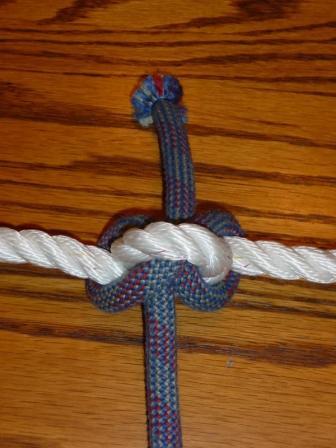
Your flair for drama will win you a photo from me, before
I retire. Shown is some 5/8" CoEx PP/PE laid line tied in
a bellringer’s loop (i.e., #1010de-collared) bearing much
more weigth than that empty chair of yours --sit your bum
(or you son’s) in that chair and THEN take your photo(!)–;
in fact, it has 125# of barbell weights suspended from it.
Behind and not much visible is like-sized manila rope in
which I stood in a (lousy) 5:1 pulley, locking a 'biner
(so, > 200#), in the same knot.
Now, to be sure, if it came to comfort and assurance, I
would prefer to sit with you and your structure (though
that kernmantle is making me wary) vs. the other.
But, again, my point is that stabilization of the knot is more
than a during-loading task, in common applications, and
the collar is needed for that, in both of these cases.
[u][b]ON THE CONTRARY[/b][/u], the un-collared loop of the common ( right or left hand ) [i]bowline,[/i] can not !
... of course, because the loop is instantly deformed into a helix, and then into a straight line...
You may examine my photo for edification, and then,
as you say, "please, correct this erroneous comment ! ".
Regarding the [b]nonsense of [u]priority[/u][/b], read the following comments by me, at another occasion :
Your reading wanders far from the written text, it seems;
I made no statement of “priority”, and --what I think you
are whining about-- simply stated my familiarity with the
knot (which included my first testing, by a then IGKT member).
I understand that you made an erroneous statement, and now you try a desperate contre-attaque, just in case… Ok, I will not charge you more for this…
I did not say that the not-collared loop is a “bowline” (!), or that it is a safe loop to use without a collar, in maritime or any other use ! Read my lips :
Have you read those words, or lips, of mine ? If yes, you should have realized that your first round of contre-attaque missed your target completely…
So, when you boast of been able to criticize a knot, read the words, or the lips, of the person that presents it, MORE CAREFULLY, and then practice tutorship…
Thank you very much, indeed ! However, if this “before I retire” is not yet another figure of speech, in accordance to your flair of drama, I would like something more :
Your unearthed notebooks, perhaps with fresh comments about the knots shown there !
Again, my point is that the “proper” collar s primary task is to pass the tail through the nipping loop for a second time…and that, incidentally, miraculously, the “proper” collar of the common bowline manages to stabilize this nipping loop, and prevent it from deforming into a helix, WITHOUT any additional structure. In the double, crossed-coils bowline, this goes one step further : the collar is not needed to stabilize the nipping loop at all, which is very well stabilized by itself. Of course, with heavy loading, every part of the knot comes together, and the collar would help the nipping loop from deforming …but its role in this would only be secondary, because the structure of the crossed-coils nipping loop manages to do this by itself, very well.
So, I would predict that a "ABoK31010, with a loose collar, would hold
…BUT a double, crossed-coils bowline, with a loose collar, would hold MUCH MUCH better ! Is this so hard for you to understand, I wonder… That proves that the role of the “proper” collar in stabilizing the nipping loop is only secondary, in comparison to its role as a means of the tail to be secured by the nipping loop easier. It proves that the collar is a structure of the tail, AND that the security of the tail is the primary purpose of this structure . It is not meant to prove that we do not need the collar, for KnotLand “God” s sake !
I never said that, momentarily, even the “ABoK#1010” would not hold, especially if it is tied with this ancient, worn out, hardened, rough, eager to retire material of yours… As you said by yourself, with my slippery kernmantle material, you would need magic powers, (and no wind…) to achieve this. If what I have written was indicating such a thing, I have no difficulty to say that I made an erroneous statement ! What I meant is that the collar is, evidently, MUCH MUCH less needed, as a means of stabilizing the nipping loop, in the case of the double, crossed-coils nipping loop, than in the case of the common bowline. Now, in securing the tail from sliping through the niping loop, the collar might even be MORE indispensable in the case of the former, than in the later…because it might turn out that, without any presence of a collar, the single nipping loop - if, somehow, is stabilized by an external means - holds better than the double nipping loop ! So, I am afraid your contre-attaque fired at a decoy, and missed this target as well…
So, do you say that the maximum loads that a not-collared naked nipping loop of a “ABoK#1010” can bear, and a double. crossed-coils nipping loo can bear, ON THE SAME MATERIAL, whatever it is, are even comparable ? If you do, then mail to me those notebooks of yours at once !
I have never questioned your familiarity with this knot, as well as with many others. But what exactly was the point of this declaration, which comes times and times again, with so many knots ? I said that "Along with the other dozens of dozens of the knots you devised (?!?) ( nothing earth shattering, you just saw something anybody else could do…and then you have forgotten it, like anybody else could do, too…), it is not a miracle that you have tied this, too…However, you have not understood its importance, not then, not even now, decades later ! "
And I said that because the strangeness of this knot has to do with how miraculously well it holds, given its simple structure, and not with the wider curvature of its Standing part ! What you sought in this knot was [i]" making the SPart take a gradual curvature into the knot… [and] had one token of it tested…"/i. Well, I have seen something else/more, much more important…and tested it with dozens of tokens. Of course, I would nt put anybody on that chair, not even you, with all your Lehudini abilities of escaping criticism and suspended animation…
P.S. Nice picture, IN the Wild of your entangled quantum environment…I guess it will take a while to desipher your similary arranged notebooks, so you should start at once !
You will be surprised of how heavy is this chair, and how much more load can this knot bear…Of course, I will not put anybody on it, before securing the single-line tail even further, with two half hitches.
The Bellringer knot is based upon the stiffness of the double-line tail that pass through the nipping loop. I have not seen a Bellringer knot with a single, flexible and slippery single-line, have you ? The double, crossed-coils loop I have presented, (only as a counter-example of your claim that the collar is needed mainly to stabilize the nipping loop…), this loop IS NOT based on this effect, it can withstand loading even when a single line passes through the nipping loop, and even if this line is flexible and slippery. Big, Huge difference ! If you say that this loop is a Bellringer-type loop, that it is holding with the same mechanism as the Bellringer knot, then I am afraid that you have not yet understood a thing about it…Tie a pair of interlinked loops on the same material, whatever this might be : a single-line Bellringer knot, and a single-line, double, crossed-coils loop, and pull them apart. And/Or, a double-line Bellringer knot, and a double-line, double, crossed-coils loop. You will see at once which loop gives first ! I have done it, with many tokens of pairs of knots with my materials, and it is needless to say that the Bellringer knot was deformed before the double. crossed-coils loop, at all times…However, I have only a collection of climbing kernmantle ropes, so I really can not tell what will happen with stiff anacondas…Try this simple test by yourself, on your material, it takes just a few minutes…and we spear the typewriting !
Any interested reader wishes to see the effectiveness of the single-line, double, crossed-coils loop in holding the tail satisfactory well, in comparison to the effectiveness of a single-line Bellringer loop, is kindly requested to test an interlinked pair of them, and report his findings to us here.
Could I respectfully bring you gentlemen back from your delicate exercises in levitation, and ask how this is taking us towards answering the OP - “What defines a Bowline?..”
The (disputed) ‘King of Knots’ is not something that teeters on a knife edge of stability.
Are either of you seriously (even for a moment) suggesting that the presence of a turn component is the essence - the ‘Definition’ of a Bowline? If not, then please help me understand just what it is that you are exploring…
I might have a suggestion regarding the definition of a Bowline type of knot.
We have seen that there are several bowlines, called so, that do not have the same type of nipping loop; it might be a turNip or it can be a half hitch. But there are always two elements present that do not change as much. It is a loop knot, and one leg of the loop comes directly from the nipping structure, while the other goes into the nip, takes a U-turn around some part, whereupon it comes back into the nipping turn once more, by its orientation stabilizing the nipping turn, so that it cannot open any more by forming a more extended spiral instead of a nipping turn. I think the collar is an integral part of a bowline, without it, I wouldn’t see it as a bowline.
Then we could see the Myrtle as a derivative knot that does not fulfill all requirements, while the Eskimo Bowline will, as well as the Double Bowline and bowline on a bight.
Then of course we have those simplest structures under that definition, the variations of the proper bowline with just one nipping turn. Even those may be further classified regarding the shape of their nipping turn, whether it is a turNip (round turn) or a half hitch.
The problem is the same old one : Is the collar an indispensable element of the bowline, or not ? Should we define, as “bowlines”, all the end-of-line loops that, among other things, have a collar, or not ?
When one tries to answer that question, he has to clarify what the collar really is, so he has to explore what the collar really does. Dan Lehman sees the collar as a means/structure to stabilize the nipping loop, so he is ready to accept other means/structures to achieve the same goal - like the Myrtle collar, for example. So, he is ready to incorporate more collar-like structures into the family of collars, and more nipping-loop-based end-of-line loops into the family of bowlines. Then, it is only natural for him to say that this generalized collar is only a secondary structure of this family, and that we must define “bowlines” without any notion to the collar at all. Indeed, if a collar can be almost any convoluted enough structure around the nipping loop, that helps it be stabilized, one can not but narrow his focus on the nipping loop itself. The generalized collar is lost into the bowline s nub, and what is left, and really matters, is but the nipping loop.
I follow a different, perhaps more naive road. I see the collar as a means/structure of the tail, that helps the tail to achieve its primary purpose, which is nothing else but to be securely attached to the standing part, to form a fixed end-of-line loop. So, for me, the collar is not a structure that was meant to stabilize the nipping loop, but a structure which was meant to help the nipping loop nip / secure the tail more effectivelly. Only incidentally, that same structure, the “proper” collar, manages to stabilize the nipping loop as well, that is, prevents it from being deformed into an open helix. So, the collar is not a servant of the nipping loop, but of the tail. Can we have a nipping loop that does not need the services of a collar ? Yes, we can, as shown by the example of the double, crossed coils nipping loop, that, being so stable by itself, needs the collar much less than the common bowline. When somebody sees the collar like this, he can resist from the temptation to open the Pandora s box, and accept more general forms of the collar, and more general forms of end-of-line loops as “bowlines”. The “proper” collar keeps its individual, instantly recognizable character, and, doing this, it is not lost into the bowline s tangled nub : it retains it role as a structure of the tail, independently of the nipping loop. However, because “there are bowlines that hold even with a loose collar, but not with a loose nipping loop”, I think that the primary structure of the bowline is the nipping loop, but that the collar is also an indispensable element of it.
So, not having to accept more general forms of collar, because the “proper” collar is so successful in its primary and secondary role without any additional structure, I am not obliged to widen the class of end-of-the-line loops I see/define as “bowlines”.
Of course “The (disputed) ‘King of Knots’ is not something that teeters on a knife edge of stability” ! However, we “analyse” this bowline into elements, as you do, and try to see if those elements are stable by themselves : if they are really individual structures, and if they are indispensable to the compound structure of the bowline. I have tried to show that those two elements I use as building blocks of the “bowline” model, the nipping loop and the collar, are indeed individual elements, and, although they work together as a pair in the final compound knot, they have a clearly separate role to play, and that they can play this role even in the absence of their pair. In the Gleipnir, we have a nipping loop without a collar, and in the double, crossed coils nipping loop, we also have a nipping loop that is very stable by itself, again without the presence of a collar. That means, for me, that the collar is a separate structure of the tail, not of the nipping loop, and its role is to help the nipping loop secure this tail, not to help the nipping loop stabilize itself. Dan Lehman sees the collar as a structure that is helping the nipping loop be stabilized, so he considers many different, more general collars, so he sees the collar as secondary structure. Nobody said that we can have a bowline without a “collar”, we both accept that there are reasons that the collar is needed, indeed, but we are talking of different reasons, and of different collars !
Do you think that the other leg of the loop can go into the nipping turn once more, following the same route as when it departed from it, or not ? Should it come into he nipping loop pointing towards the opposite direction it had when it was exiting from it, or not ? In other words, is the Myrtle collar a “proper” bowline collar, or not ?
I am not satisfied by this vague “directly”…I like the idea, that throws the Karash loop -and other crossing-knot based loops- out of the bowline family, but how we could quantify it ? Is the leg of the nipping loop. in the “reversed” Constrictor bowline, coming directy from the loop, or not ? (See picture)
The fact that the not-collared, double, crossed-coils nipping loop can hold so well, is an indication that, in the collared, bowline version of the same knot, this nipping loop would not depend very much on the collar, to retain an effective nip on the tail. See the attached pictures for such a loaded loop, where, even if the two coils settle in inclined positions relatively to each other, the “8” shaped nipping loop remains in a closed, functional shape.
There might be many more complex nipping structures, that can be stabilized by themselves like this one, without the help of a collar. This shows that each of the two essential elements of the bowline has an individual role to play, and that both elements are indispensable in the compound structure of the bowline knot.
I have received a request to move this thread to a more suitable location on the grounds that it is a purely theoretical discussion, rather than a practical one. Please may I have a concensus of opinion as to the suitability of the Practical board for this discussion’s home, as I am loathe to move a long-established 10 pages or so of discussion and good photos without a majority agreement.
All in favour, please post ‘aye’ for a move to Knot Theory, and all those against please post ‘no’. Justifying your post to the left or the right is purely optional…
But I have one expansion, in that “end-of-line [eyeknots]” isn’t
my limit; I will (or might, pending further ruminations) include
mid-line eyeknots --well, what of the basic/common bowline
serving so (and, yes, there are those that can be tied w/o ends)?
This all touches issues regarding how knot is defined,
vis-a-vis loading (or not) and so on, so I don’t want to throw
in a load of other considerations at the moment.
And I remind all that with some greater expanse of examples
to consider, there might be some revisions to current thinking.
I.p., re the Eskimo bowline, surely if one accepts that there
is a distinction of SPart-cores between the turNip and the crossing knot (aka Munter-hitch form), then it should be seen
that the latter will lay equal claim to this eyeknot.
I have called the mid-line knots shown in (1) as “midline bowlines”, probably for the same reason. ( In fact, they were nothing but mid-line Janus common bowlines - as the beautiful knot presented in the same thread by Dfred was nothing but a mid-line Janus Myrtle loop …)
There are many knots where some small - or even some larger - parts of them are not loaded at all, but those unloaded parts are necessary and functional elements of those knots nevertheless. Their mere presence, in the particular position, into the knot s nub, their mere volume, the fact that the segments of the rope they are made of are incompressible, all those things- that have nothing to do with flexibility and resistance to longitudinal loading - allow those knot to be knots. So, yes, been loaded or not does not make an element of a knot more or less necessary to the knot…and a “knot” should better be defined without reference to the loading or not of some of its parts.
The Myrtle does not have a collar, it has two enmeshed nipping loops.
And what is this “‘proper’ bowline collar”? Just because the bowline has a collar, or a nipping loop, does not make these components exclusively ‘bowline’ components with the inference that any knot that contains either one of them is perforce a bowline.
They are components that comprise the bowline and can be part of any other knot without needing to call that other knot part of the bowline family. If we start to say that any knot that has a half hitch component is a bowline, then where is the logic that prevents us from defining the bowline to be a Gleipner or a Myrtle etc. etc.
How can it be rational to claim that the presence of a single component defines that knot as a bowline?
Aye from me as well Glenys as I could imagine that one might ask “What defines a Zeppelin?” or “What defines a Clove Hitch?” These could easily lead to the same type of discussion we see here. These discussions are primarily nomenclature from my perspective and belong in the theory section.
Btw, the joining of two ropes defines a Zeppelin, so, instead of calling the family bends, we will now be calling them Zeppelins in accordance with a possible prime example / archetype for the family. So, we will have the Hunter’s Zeppelin, the Ashley’s Zeppelin, the Alpine Butterfly Zeppelin, the Figure 8 Zeppelin, etc.
No, the thing you think it is a nipping loop, it is not ! It does not have both its legs loaded, as any nipping loop worth its salt : it is a collar, in the generalized sense, or a hitch.
The bowline has a (“proper”) collar ( a structure of the tail, tied around the standing part ) AND a nipping loop ( a structure of the standing part, tied on the standing part). If an end-of-line loop has both those things/components, and can be completely untied when those things are untangled from each other, then yes, it is a bowline !
The bowline is a Gleipnir WITH a collar. The Myrtle loop is not a bowlne, because the Myrtle collar is not a “proper” collar. If ANYTHING from the “etc, etc” has a nipping loop on the standing part, and a “proper” collar on the tail, and can be completely untied when those two structure are untangled, then it is a bowline. Those three characteristics do not prevent us from defining something as a bowline, they oblige us to define it as a bowline !
It is the ONLY rational thing ! The presence of those three (3) characteristics, the two components ( nipping loop and "proper"collar) and the condition that the nipping loop structure is topologically equivalent to the unknot, define a knot to be a bowline, indeed. Nothing more, nothing less is needed.
Unfortunately perhaps, the “joining of two ropes” is not a sufficient condition to define a Zeppelin bend. (The Zeppelin bend is a rope-made hinge, the first bights are not interlinked, etc etc ) But every knot that is similar to the Overhand knot, instead of calling it with another name, we are calling it as an overhand knot, double overhand knot, etc, aren t we ? The same happens for fig 8. knots, because the archetypal figure 8 knot helps us define any knot that is similar to it, as a fig. 8 knot…The same happens to the “Crossing knot”, to the “Gleipnir”, etc etc.
If that ““argument”” was the reason you "voted’ as you did, I can understand it…
The Zeppelin is a prime example of a bend, is it not?. So, in accordance with the proposals I have seen for bowlines, we should use the name Zeppelin in the naming of the family for which it is a prime example. I’m not saying that I think this is a good idea. I’m just extrapolating (yes, and exaggerating for the purposes of making the point) what I have seen suggested for the “Bowlines”.
It is not ! The Zeppelin bend is a rather isolated interlocked-overhand-knots bend, I would even say a unique example of this family. None of the 7 well known interlocked-overhand-knot bends are really similar to the Zeppelin bend, and that is due to the fact that all these bends are retucked Reef-like bends, UNLIKE the Zeppelin bend…( See (1)),(2)) You have chosen as an example the only bend you shouldn’t !
As you know, people nowadays are making words, even verbs, from companies that offer a specific product ! You can “google” some words, “xerox” the results, and then read them to see what I mean… Is the “bowline” your biggest problem ?
Your argument is completely wrong, for yet another reason. It is reasonable AND useful for a generic knot to be used as an example of some basic function, and vice versa. The archetypal form of the nipping loop is nowhere so clearly seen, without any additional structure, as in the Gleipnir binder knot. If we call a certain knot structure as a “Gleipnir loop”, we all know what we mean, and, moreover, this name helps us understand that we are not talking about something else… Knots with such a long history, and of such an importance, as the bowline, are expected to serve as benchmarks for families of knots that bear some resemblance to them. I really do not understand this name fundamentalism…Is the “bowline” a sacred thing we should leave “unspoiled”, away from any other knot that can taint it ? I am a great admirer and user of THE bowline, yet I do not have any problem if, by this name, we call a number of similar end-of-line loops…On the contrary, if the name of a particular knot is used for a family of similar knots, this is a honour, so to speak, to the parent knot, isn’t it ?
Anyway, the subject of this thread was not the name, but the “structure. characteristics, topology” of the bowline, and the various other similar bends were used only to test the proposed definitions of the bowline.
As the vote-notice and two votes on moving this thread
to Theoretical have intruded here,
I here vote YES : i.p., I think it important that the “Theoretical…”
forum have such activity, and not be thought of as so removed
from things practical (aspects & considerations of …).
Currently, Practical is highly active, of our well-divided lot;
Theoretical too much ignored. Our considerations here go
to how we conceive & treat & think about practical knots,
and not to the practicality/use of them, per se.
.:. It is fine that this active, engaged discussion vitalize
the Theoretical chambers --we do have such thoughts,
about our knots! (And we have some currently quiet but
of continuing interest threads there re nomenclature,
which this can see informing.)
(And, having moved (or knot), the Vote msg.s might best be
deleted.)
PS: Some time ago a thread was deemed to practical for
the Theoretical forum and thus moved …
INTO CHIT-CHAT ??? ?! HUh, I voiced dismay at this before,
and will do so more visibly now; that thread, launched by the
right rationale, belongs HERE.
(We might regard the two moves, now, as a sort of trade.)
 Ok, I will not charge you