What defines a Bowline? - structure, characteristics, topology

My vote also is Yes, as I all the way thought this was a theory discussion.

Then on the continuation, about “proper”, I used it only to denote a particular part of the very knot we all know as a Bowline, the “right-hand” one, somewhat distinct from the Dutch Navy, Cowboy, Bowline. Of course other designations might be preferred, but we are on a nomenclature discussion, and it could help to be clear. So it is only a matter of definitions, not a semantic one denoting qualities.

Theoretically, I think it should be put into" Knot Theory", but, in the end it makes no difference to me. The discussion will continue.

I thought that we had established early on that a fundamental part of the definition of the bowline is that it is a loopknot. Indeed, this is such a fundamental, we hardly have a need to reiterate it.

Now you are offering us your newly coined term “midline bowlines”, and an image to go with it - vis.

http://igkt.net/sm/index.php?action=dlattach;topic=3233.0;attach=5656;image

The orange cord shows an end, so that can’t be the ‘midline’ part, leaving the white cord as the aspect the ‘midline’ must be referring to.

But the white cord only has a Half Hitch Component, and this is stabilised by a Bight Component and a Janus tuck (i.e. opposing Bight Components) from the end of the orange cord.

There cannot be a loop in this construction, so how on earth can you call this a bowline, ignoring the simplest and most fundamental part of the definition of a bowline?

It is a lovely knot and we might call it the Janus Hitch - but there is no way, after all the discussion thus far, that you can expect to attach the name bowline to it…

In fact, this is an opportunity to propose to nail one tiny aspect of the definition of a bowline - vis

1. A Bowline is an end of line [note 1] fixed loopknot {.EyeKnot}
[note 1 - a Bowline may be tied inline on a bight, in which case the bight is considered as an inline device to create a doubled ‘end of line’ element]

and carry on a little with :-

2. A Bowline is defined and described in ABoK as 1010

3. A Bowline construction comprises a load line, a knot, a fixed loop and an end

4. A Bowline knot has two components, a Half Hitch Component connected to the load line and a loop leg and a Bight Component connected to a loop leg and the end [note 2]
[note 2 - the Half Hitch component transfers load into both loop legs through the turn element and the high nip force generated causes frictional entrapment of the end. The Bight component acts as the core for the Half Hitch component and stabilises it via its bight collar made around the loaded line]

5. A Bowline’s Operational characteristics are :- …

6. A Bowline’s Usage characteristics are :- …

7. A Bowline’s Historical characteristics are :- …

8. A Bowline’s Aesthetic characteristics are :- …

9. …

Derek

I use the term “common right hand” bowline, for what you call “proper”. Of course, the use of the term “proper” here is wrong, because there is nothing essentially different, or improper, in the left handed bowline. Moreover, I do not really know if most people that actually use the bowline, the amateur and/or the professional sailors, do tie the left- or the right- hand bowline most of the times. ( Of course, the vast majority of them do not know anything about ring loading…and the same can be said for the cowboys, or the marines of the Duch navy :))
The use of the term “proper” for the collar of the (left and right hand) common bowline ( i.e the collar where the working end, after its U turn around a segment of the standing part, returns to the nipping loop by the same route, and it enters into it pointing to the opposite direction from the one it was pointing to when it exits from it ) is more justifiable. The "proper"collar, and the Myrtle collar, for example, are indeed very distinctive, as the former manages to stabilize the nipping loop better than the later -without any additional structure-, the former makes a tight loop in and around the nipping loop ( to the degree one can confuse it with a nipping loop…), while the later does not. So I believe that the use of the term “proper” for the common bowline collar is reasonable, but not for the right hand bowline.

My dear Drek, do not waste your reasoning abilities for such self-evident things… :slight_smile: Better read the f… thread !

There is no “Half Hitch component” there, or any hitch component whatsoever, I can assure you ! :slight_smile: What your eyes see is only a nipping loop, a bare, naked nipping loop, with both its legs equally loaded. Your mind can see other things, of course… :slight_smile:

Of course, it is not a end-of-line loop ! Even “I” can see that :slight_smile: ! But the structure is identical to the structure of the (Janus) bowline, as both of them have one of the four ends unloaded. The name was pointing to this fact, as this knot CAN NOT be confused with an end-of-line loop ! I though that this name was helpful for one to see how this knot works, rather what this knot look like - it obviously does not look like a end-of-line loop, so there is no danger of any confusion there.
When there was a long discussion about the so-called “Zeppelin loop”, that is a loop that BRUTALLY destroys the essence and beauty of the Zeppelin bend, its remarkable symmetry and its rope-made hinge character, I have not seen anybody here say a word…
Anyway, if the name “mid-line bowline” is such a disaster, we can forget it. On the title of this thread, I used the term “midspan bends”, and I have introduced the name “midline bowline” very cautiously. Please, suggest something more “proper”, but in the “proper” place, the above mentioned thread… :slight_smile:
( I brought the issue here only as a reply to Dan Lehman comments, on Reply#148.)

I demonstrated extensively, back in post 65, examples of the Half Hitch Component with both sides of the hitch loaded. In ABoK Ashley describes 160 and 161 as hitches where the HH Components are made onto rope, again both sides loaded (indeed, were it not for the missing bight component in 160 and 161, they are both bowlines)

http://doit101.com/Knots/images/fig39.gif

What you have shown in your image is the Half Hitch Component, ‘hitched’ to two Bight Components.

http://igkt.net/sm/index.php?action=dlattach;topic=3233.0;attach=5656;image
You even have it arranged with the crossing legs, rather than the Turn Component the Bowline component morphs into under load.

What my eyes see, and what my definitions describe are exactly as I have stated - A Half Hitch Component made about and stabilised by, two Bight Components.

Derek

While one can find the fuzzy boundary and similar geometry
between this conceived “(half-)hitch” & “nipping loop” pair,
the former really includes a notion of self-nipping (i.e., of
a loaded end on a tail) in contrast to the latter’s absence of
such notion --and put load on the photo’d white rope and
you might see it lose contact w/itself as it rights itself
towards helical form.

Of the old-image timber hitch + half-hitch (and, NB, I refuse
to use “Killick” (etc.) here, seeing that as a unified like
structure for a different purpose), the in-question component
straddles/spans the distinction between the paradigms
for these conceptual constructs. We must operate with
fuzzy boundaries, here and elsewhere.

And so I don’t accept calling the loop-finish to the turNip
base another nipping loop in the first; but, then, I don’t
so much care one way or another, in re my thoughts about
grouping a family of such knots as “bowlines”, at the
moment --preferring to take the SPart’s structure as the
sole or key criterion w/o further precaution.

–dl*

ps: [Really, that supposed counter-comment about moving
this thread to a less active Decorative Tutorial ought not to
have been made! This thread is --per OP/topic-- about the
definition/defining-essence of a particular knot,
not about its use, viability, practicality --though it concerns
such a knot as the focal point. That is the topic; any further
posts that range OT into practical concerns are, well, OT
(off-topic), and should not move anyone to re-Moving.]

Ashley is wrong there, as in many places, because he is no “God”, and you are not His prophet ! :slight_smile: When you cite Ashley as your “proof”, you only show signs of argument weakness…Your other arguments are demolished back in Reply#66 and Reply#73, and I do not want now to raise clouds of dust from those ruins again… :slight_smile:

When a loop (around a line or a pole) has both its ends loaded, it is not a hitch, it is a nipping loop.

No, of course not. The white rope forms a clear, bare, naked, archetypal, Gleipnir-like, NIPPING LOOP !

When a loop (around a line or a pole) has both its ends loaded, it is not a hitch, it is a nipping loop.

P.S. The funny thing is that you “see” a hitch, where there is only a nipping loop, but also you “see” a nipping loop, where there is only a hitch :). You describe the Myrtle “generalized” collar / hitch as a nipping loop !
[i]“The Myrtle… has two enmeshed nipping loops.”/i
Derek, sorry my friend, I was wrong…You do not need a chair, you need a new pair of glasses ! :slight_smile:

From this comment I understand that you do not know why I have arranged them so…because you have not read (1). I repeat the reason here, so you would not have to push many buttons…

"There is a simple reason for it, that I will try to explain. I wanted a “mid-line bend” that was able to withstand even a lengthwise pull of the attached line, so I made sure that the free end of this line remain as near the point where the ends of the nipping loop touch each other, and as near the axis of the main line, as possible ".

  1. http://igkt.net/sm/index.php?topic=3020.msg18419#msg18419

The term “Knot theory” means something to all people, except to the members of the IGKT Forum. As we are not sooo many, nobody seems to give a penny about this misnomer…
What you describe as “Knot theory”, is probably nothing else than the examination of practical knots as such, without any reference to a specific application. This examination could be the subject of a discussion, and this discussion could help somebody, somewhere, sometime in the near or distant future, to propose a “Theory of Practical Knots”. I believe that I will not live enough to learn the first such theory… :slight_smile:
So, the real distinction is between “Applications of Practical knots” and “Characteristics of Practical knots”, to use the first quasi-real descriptions that comes to my mind. The distinction between, from the one hand, a section of a non-existing “Theory of Practical knots” ( sorry, the term “Knot Theory” for this makes me laugh, so I can not type it…), and, from the other, a “Practical Knots” section, is absurd. Of course, there will always be people that fear, so hate anything has to do with theory of anything, so those people will not care if the term “Knot theory” means something else to all people on Earth but them…and if there is not any “Practical Knot Theory” to anybody s mind, and if, by the term “Practical knots”, everybody should mean something more than “Applications of Practical knots”…
Is it a matter of “vote” ? Of course not ! Vote means something very valuable, lives were sacrificed for this right to be conquered by the members of a unified group of people, ready to die for their city, for each other, and from any possibly wrong consequences of their decisions. What is described here by “vote”, has the same relation to the true vote of citizens, as “Knot theory” has to the knot tyers…i.e, none whatsoever ! :slight_smile: People confuse vote and the decisions of the citizens of democracy, with polls and opinions of the spectators of mass media…And when they do not really know what to do, they start counting:slight_smile: The advantage of such an attitude, is that one can even fall asleep, using this wise ancient method ! :slight_smile:

No comments.

Oh Xarax, yet again you are so wrong… Indeed I need glasses - but I ALSO need a chair, for this process is so tiring…

But I think perhaps I can see (with my new glasses perched jauntily on my nose) what it is that is leading you away from understanding what I am attempting to communicate. I think that you are getting hung up on a name.

When I first started to explore the components of a knot (as many more before me doubtless have), I chose names for the components that I had identified based on what I thought they looked like and what I felt they did. But they were just names that I chose like the Simple Hitch Component and the Half Hitch Component. These names are causing you problems because of your fixation with what you see these names as meaning.

If however, I had chosen a name such as the ‘Morphing Overlaid 180degree Helix Component’, you would not have the same preconception and might be more predisposed to accept the component for its function rather than by what you see the name as suggesting from a fixation with terms such as ‘Hitch’ or ‘Bend’ etc. But you need to forget these old words - ‘Bend’ after all is such a ridiculous term for a connecting knot. I predict that you and I may well live long enough to see the demise of mess we presently have for naming our knots as the next generation of Nodeoligists cleans up the mess of ages.

Try to see beyond your preconception - make up your own names for these components - and build from that.

Derek

You too ! :slight_smile:

Me too ! And, sometimes, I need that chair you have e-mailed to me ! :slight_smile:

Most probably…because you hanged it around my throat ! We should better use symbolic notation, or entirely other words, that do not bear within themselves memories/meanings of familiar things.

Wrong choice ! As with women, one should be careful how he calls them…Knots are jammed in our mind, we can not forget them !
My real objection is that you choose names for the components according to what they look like, not what I feel they do ! When I read/ hear the word “Hitch”, I have in my mind a certain function, which is the miracle of an inanimate thing, that somehow manages to keep one of its leg free of tension, while we pull the other as hard as we can ! I follow the flow of tension into its body, and I wonder, how on earth this flow disappears after a certain rope length ? And here you come, and you destroy all that, naming “Hitch” something that allows this flow to pass through, from the one leg as well as from the other ! You twist the hitch s arm and my mind !

Oh ! I am too old to forget old words, and to learn new ones ! Why you insist to use those words, and run the danger to induce confusion against your will, and do not use other, neutral, safe, abstract words instead ? You need to use other words!

The misconception of names was all yours ! You could well have chosen other names, define their meaning carefully from the start, and spear us the typewriting ! It is you who proposes an abstract scheme - so needed - for the explanation of knots, not me. When I have attempted something like this in a smaller scale, and far less ambitious, I used old names of things to describe just those things…like “nipping loop” , or “riding turn”, names that instantly drive the reader to the correct object, and only afterwards attempt to push him a little forward from the familiar place…You take a name that means something very specific, and you pull it from every side of it, and make it large enough to cover new areas…This in not a generalization, this is an ignorance of the laws of language, which, my dear Derek, “does not have bones, but it crushes bones…” Language should be respected, it is the great tool of humanity to reach the meaning, and to explore the world. You are not allowed to use words that mean another thing, for something else ! A hitch is a hitch, for KnotGod s sake, and a nipping loop is a nipping loop !
I believe I am one of your most devoted students, commited to this valuable endeavour to clarify things, to explain things, to reduce the apparent complexity of the KnotLand to something more fundamental, essential, and to open the road for the new generation of knot tyers, to the Holy Grail : A true “Practical Knot Theory” ! As a teacher, you are the one that bears the burden to use the most smooth, easy, step-by-step method …and what you are you doing ? You insist of playing with our minds, of forcing us to speak familiar words while thinking new meanings…I do not blame knot4u, and the other young guys, that they come to hate our guts… :slight_smile: They do not wish to speak the language you wish them to learn, they do not wish to twist their minds, simply because they have better things to do ! :slight_smile:
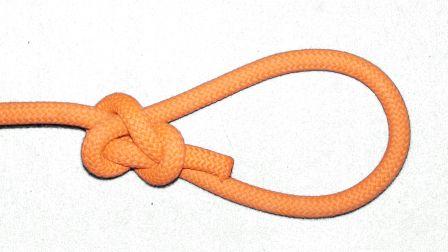
That is our main difference. You name things based on how do they look, to the knot tyer as a spectator, I try to think of things based upon what they are, to a knot tyer that is part of the rope itself ! I imagine I am the rope, and I am pulled and twisted by you, the knot tyer…Which parts of my body will fell something, which something else, and which nothing at all ?
This is called an “intrinsic” description of the object. You do not see it from outside, in fact you can not see it from outside ! You only follow the flow of forces, you put yourself within the rope, and you try to imagine what the knot really is, and how it manages to be what it is…It is like when we speak about curvature of the surface of a 2D object : You can see the surface of the object from outside, from your flat 3D world, and decide if it is curved or not, and how it is curved. But also you can do the same thing, AND MUCH BETTER, if you are inside/on the surface of the object, if you belong to its 2D world, and measure the curvature from there, and from there only. You just have to follow a circle, and to measure the length of its perimeter and its radius. If the ratio is 2π, the surface you are on is flat, if it is greater or smaller than 2π, the surface is curved in the one or the other sense.
When I am inside a loop, and one of my legs is pulled ferociously by you, while the other is free, because I was clever enough to put it underneath the one pulled, and to secure it so, I know I am part of a hitch, I am a “hitch component”. When both my legs are pulled at the same time, and I can not cross them, but the only thing I can do, is to constrict the object (line or rope) that pass through my hug, then I know I am a nipping loop, I am a “nipping loop component”. I do not have to be in your position, to look to myself from outside, to decide what I am ! I only have to measure things from my world, the world of the tensioned, curved, twisted rope…
So, when I am in the bowline, I know that I am a nipping loop and not a hitch, because the standing end and the eye leg of the standing part pull both my legs, and the only thing I can do is to squeeze the two legs of the collar that happen to pass through my hug…and I do not listen to you, that keeps telling me I am a “hitch component” ! I know better than you what am I, because I am there, into the flesh of my body, while you are only outside it, a poor spectator of my skin… :slight_smile:
I have not suggested to you to buy a new pair of glasses, just to “see” the skin of the knots…but to read what you write, :), and “see” better through this skin, the flesh of the knotted ropes ! In the common and Eskimo bowline, there is no hitch present, only a nipping loop, and a “proper” collar. Any hitch component worth its name should have managed to have the one end/leg free, otherwise it is a - more or less successful - nipping loop. And I am saying this, because, if this nipping loop is twisted more than a certain degree, it becomes a “Crossing knot Component” :slight_smile: :), and it becomes less strong in its gripping power on the tail.

Indeed I do, and my lesson is, I hope, well learned.

Derek

So, according to this view, what is a bowline ? An end-of-line loop that happens to be fixed, when we manage to stabilize a TIB nipping structure tied on the standing part - so it does not deform into a helix, and does not “walk” down to the tip of the loop. The ancestor of Dan Lehman figured out that he could not attach the tail on the straight tensioned line of the standing part ( he had not yet discovered the climbing friction hitches, and the ww hitch…), because any straight tensioned line is very smooth, very slippery… so what does he do ? He makes a standing part segment a little less straight, a little more curved, a little more convoluted, so his tail will be stuck on a obstacle, and will not slip alongside the standing part. He tries a simple turn, and he tries to make this turn stay as it is, and where it is…that is, not deform into a straight line again, and not revolve and walk down towards the tip of the loop. Trying all the possible ways to achieve this, he passes the tail through this curved standing part structure, he passes it around it, over and under it, anyway he can. The “proper” collar is not but one of the possible such solutions, but there are many others. So, all those solutions to this problem, the stabilization of the nipping structure in its form and its position on the standing part, are “bowlines”.
My ancestor was thinking otherwise. He has this end, the tail, and he tries to fix it on the standing part. He encircles it with the standing part, with the hope that this embracing will be enough, will grab the tail and he will not need anything else…Nooope ! His tail slips through the nipping loop, like his wife from his hug…so what he does ? If once is not enough, try it twice ! ( With women, one has to go to bigger numbers, of course… :)). He passes the tail another time through the same loop, driving it along any route he could think of. So he ties a Myrtle loop, a common bowline and an Eskimo bowline. Then, he chooses the bowline, simply because this solution is holding better than the others, without any additional structure. The problem of stabilization of the nipping loop did not even crossed his mind, because he sees the whole problem as a problem of attaching the tail on the standing part, and he makes the standing part turn around the tail to achieve this, to grab the tail with a tight hug. He was lucky, because his solutions managed to stabilize the standing part structure at the same time they were nipping the tail sufficiently well. And the simplest and best solution to his problem, was the bowline, and the bowline s “proper” collar that passes through the same point inside the hug twice, following the same route.
See the attached picture, for a Dan Lehman s ancestor “bowline”. This ancestor tried a 8 shaped curved segment on the standing part, and then he passed the tail through it in the simplest way, in an attempt to fix the standing part s structure in its form and position. The interested reader will recognize this deformed, double, crossed-coils loop, with a Myrtle collar.


to be, or not to be - a bowline (side view).jpg

What is a clove hitch when tied around a stake as part of a sort
of fence line, ends running opposite directions to adjacent such
stakes, and so on?

What is the same structure when tied tightly around a coil of rope,
to bind it, ends limply hanging (tension all within the knot)?

A hitch is a hitch, for KnotGod's sake, and a nipping loop is a nipping loop !

And … in between …, or simultaneously … ?!

What is the debated component of the Myrtle eyeknot when it is
extended to make a “proper collar”?
(Which knot is, in my naming from some decade back, a BowlinaBowl. :smiley: )

–dl*

It is a “closed” hitch, which, to my view, is indistinguishable from a nipping loop.

I am sure you have tried hard to discover this case… :slight_smile:
I would say that it is a compound knot : two half hitches connected together.

A definition is never a 100% accurate/complete description of an object, or of the 100% of the to-be-defined objects. We are trying to define/classify as many things we can, with as few words as possible, nothing more -ambitious- than this ! Some small fish will go through any net…

Ha, the case has been there all along, waiting for our
attention (like so many knots await …). I think your
answer is more inventive than my question --you must
have lowered that chair and had a good sit & think in
it. :smiley:

Which exercise is good, for I have further questions (noting,
though, that my last of the above post remains unanswered
Myrtle-extended is calling you … ).

What is a simple turn (that thing sometimes views as
a “nipping loop” or a “hitch”) of your orange rope run
through the turNip of the white rope, so to stabilze
that structure, and held in its tension by the turNip ?!
You can’t call THIS any compound whatever --I’ve trimmed
it to the minimum–; and with limp ends, it fits neither
of your above-cited alternatives.

(Maybe it’s a “small fish”?)

–dl*

Easy ! It is the same kind of thing that stabilizes the genuine Bellringer s loop ( not yours, the ABoK#1010 de-collared), the Bellringer s loop with a SECOND, unloaded line that passes through the nipping loop, just to make the two-segments longitudinal element stiffer ( We meet the same thing in the Sheepshank, the ABoK#160 and #161, etc..). One or more segments of a rope can be used by a knot, even if they are not loaded by themselves, in the following sense :

I am sure that many knots, and many things about knots, are awaiting somebody else to look at them more carefully than I manage to do…Practical knots Theory is not born yet, I believe, and I am not pretending “I” know any “deep”“truth” that should be carved in stone and last for centuries ! I only try to use some simple, sometimes naive notions that might help me not get lost into the combinatorial nightmare of all the possible knots. I prefer this simple minded attitude, from the other alternative : In KnotLand, there are everywhere grey areas, nothing is black and white and as simple as it looks, definitions are impossible, every knot is a different immensely complex machine, knots are something, and, at the same time, simultaneously, something else in between… Of course, the second component in Fig. 39 of Derek Smith is not a clear- cut nipping loop, and/or a hitch, and/or whatever, and the “Myrtle extended” might be a knot element that belongs to more than one worlds/words/definitions. Are those smaller or larger fishes going to persuade me stop fishing, and start eating fast-food made by the knots-as-tools-and-nothing-else “users”, or canned-food made by some prophets and preserved into century-old sacred scripts ? No, I do not thing so… :slight_smile: