Analysis of Bowlines paper uploaded for review and comment (PACI website)

About which you should be clear, now; HOWEVER,
you would be wise to consider how well the term suits
general presentation --it would take a direct presentation,
at least. In other words, I’m clear on it and X. is and … ,
but that doesn’t mean that it is without potential trouble
if put to the general populace. And, I noted already the
“overloading” of it, as both “anti-” and “bowl,” are in
my thinking halves of anOTHER “bowl.” word. I acknowledge
this overloading --which, mind, comes also with “loop” and
why I use “eye knot”, a novel term w/o confusion from
anOTHER meaning, but just confounding a bit maybe from
its rank newness in the literature (finding companionship
in “eye splice”, I hope).

So, I wrote to clarify for you; I respect that such understanding
nevertheless might not compel one to use such terminology
overall. (SOMEtimes, the structural aspects are a blur, too:
i.e., the “opening into helix” aspect, which seems more likely
for anti-bwls, can also happen in the good ol’ #1010 (and into
capsizing to a “pile-hitch noose” or helical eye knot);
and some anti-bwls can be pretty good on preserving the
roundness of the turNip.
.:. One might sit back an reflect on how helpful the
distinction is on one’s own particular set of knots presented!?
(In other forums --here, w/knotters–, we need handles to focus
our meaning on something, and fashion terms on the fly for such
with-the-initiated chatter. What goes out to other forums might
need editing/revising/adjusting/refining.)

I also acknowledge your reasoning on the collar structure and how it manoeuvers around the SPart or an eye leg. What is needed is some clear content that is presentable in a document that can be easily understood by the general (lay) public (and with accompanying high quality photos to illustrate the concepts).
Pardon in that I've skipped this, in time deficit. I could see "bight" as maybe a helpful descriptor? One can "loop" or "bight" with a tail, in binding/securing/ stabilizing the [i]turNip[/i] --[i]myrtile[/i] loops, and #1010 bights, and [i]EBDB[/i] does both (and [i]EBSB[/i] goes off the deep end, Yo.-Yo.-ing! ;D )
Second, what you call SPart, is a WRONG term, because anything before the Tail End is Standing Part !
NO, I protest!! In fact, as I allowed earlier re the dubious *acronym* aspect to "S.Part/SPart", one might see this Dan-term as making a departure from the commonly given definition (and implications) of "standing part" --which commonly connotes a [u]inactive[/u] part of the knot [u]during the tying process[/u] (but maybe ignoring this on some *backwards*-tied knots (where shortness enables tying end-outwards, so to speak --e.g., snood to long-line of a trawl)).

What I’ve wanted was a term for the
bears full force into the nub, until U-turn (or …)".
.:. So, in that sense, one can see X. wrong about their
equality --right about the old term, wrong about the new.
IMO–, and I think most will agree, the complete knot is
in need of denotation of parts --and maybe more often
& importantly, than is the inchoate knot.
(ANd maybe “standing part” better suits its old sense,
and “S.Part” should find another term. I’ve used the
shorthand, though, as so often it is the former --or. to
X’s critique, the leading part of that-- that ultimately
becomes what I see as the latter. (I have read in Ashley
“the lead” but don’t fully grasp what he means by that,
and think it too isn’t quite what I am seeking.)

–dl*

Or not : i.e., your point should resonate strongly,
as the general reader will more likely be put off
by such number, than enthralled by all the options.
And a culling / choosing --hard though that is–
might be in order. Or some sense of principals
and subordinates?!

There can be ways to generally point to the vast
set of possibilities, showing structural parts and how
things can be modularized and modules combined
in new ways --the YoBowl finish slapped onto the
“End-Bound” wrap slapped onto the “double” turn
of common dbl.bwl., and so on.

Likely some of the knots will be faster to tie,
and others which might sell by virtue of surer
security (or more sure easy untying, where use
is of well-monitored and short-lived knot : e.g.,
on a tow line for impromptu momentary use)
might take more careful working. #1010 can
be put in with haste; more complex knots usually
not so much, but if tying in for some period of
use, the tying time is a minor concern.

–dl*

When i tie Bowline, i do it always on the same way. My principle is: it is better to know one way well, then to use various ways and don’t be sure if you did tie the knot without mistake. Xarax would said: you can not learn old dog new tricks. And I do not feel any benefit / need for different variants. Because of this I prefer this presentation (let’s call: “basic”). If it were me to decide, I would certainly call this basic view as “front”. But my arguments have no weight and depth like Dan’s, Xarax’x, Luca’s, roo’s etc. Therefore, this is only one unimportant opinion of “amateur”.
On the other hand, if I talk about the Sheet Bend - in my head I have only one image (considered as standard), which for me is the basic view. And I should like to call it “front”. But that “front view” is in complete contrast to front view of the bowline. Because of these contradictions I give up further explanation.
For me, the “front” means: The basic view that I have when I start to tie the knot.
Well, according to my vision, I always like to watch bowline in “vertical” position. And the bend in “horizontal”.
Further, it is my opinion that the Sheet Bend needs only one diagram.
Because of detailed illustrations - it is well to display both views. I would both images linked in a way to get a second look by simply rotating the bend in the area of ​​180 degrees.
Sorry, English is not my native language and therefore it is not very clear what “the poet wanted to say.” But anyway I’m honored that Mark asked me for assistance and I consider it is my obligation at least to try something. Maybe anything will be usefull :slight_smile:
Regards, ZZ


BWL (basic view).gif

Sh Bend (basic view).gif

I agree. And I would be ready to denote THIS side as the “front” side of the “corresponding” bowline. IFF the bowlines was corresponding to the Sheet bend - but it does NOT ! There is no relation, other than superficial, skin-deep, and Ashley-parroting oriented, between the bowline and the Sheet bend, but I will not repeat my reasoning here, because there are just some things just some people can not just learn / understand.

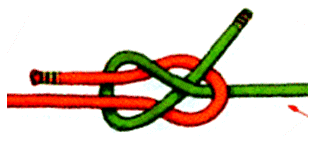
P.S. See the attached picture, for the “front” view of the genuine Sheet-bend bowline.

I was talking about the complete knot.
In the case of an eyeknot, but also in the case of the one link of a bend, we have three parts ;

  1. The Standing End. This is the part of the line OUTSIDE the nub, from the one side. Also, this is the only part of the knot which is loaded by 100% of the load.

  2. The !@#$%^&*()_+

  3. The Tail End. This is the part of the line OUTSIDE the nub, from the other side. Also, this is the only part of the knot which is loaded by 0% of the load.

    Now, one can denote the 2 nd part as he wishes - for the time being, I call it “Standing Part”, but we can well find another term, and keep the term “Standing Part” to denote a part of the knot during its tying stage ( a part of the inchoate knot ), the other part being the “Working Part”.

P.S. For yet another pair of terms, read :
http://igkt.net/sm/index.php?topic=4757.0

Hi Dan,

my term "anti-bowline" is derived from "anti-cyclone", which pertains to orientation/direction of like things --opposite only in this quality but not in basic nature, or somehow one the undoing of the other.

This is the kind of reply I am looking for - some sound reasoning to give authority to a descriptive term.

So this is your basis for preferring the term ‘anti’?

Is there wide-spread consensus for the use of the term ‘Anti Bowline’ to describe the so-called ‘Eskimo/Kalmyk Bowline’ structure? (I have trouble with the term eskimo).

That is, are you in preference for use of the term ‘Anti’ to describe any Bowline that has a collar-capstan structure that performs a manoeuver around an ‘eye leg’ instead of the SPart?

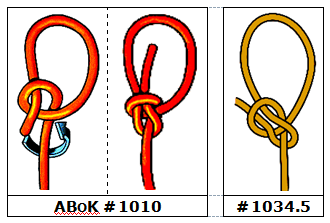
Could you also label each of the parts in the Bowline #1010 image?

Can you confirm the Bowline Vs Anti-Bowline definition image?

Can you describe the Alan Lee Eye Knot - how it fits within your definition?

Many questions… :slight_smile:

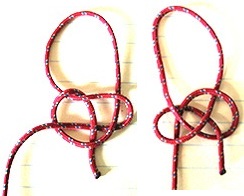
EDIT: With Luca’s help - I have added what I think is one of the worst examples of photography and topological layout I have ever seen. And Dan Lehman’s replies are all but Greek to me. In tying both knots depicted - it seems to contradict the definition of ‘Anti’ Bowline - but like I said… its all Greek to me :slight_smile:
Here is a response to a question:

Dan, which one is the Myrtle, and which one is the Anti-Bowline?

The left one, if properly oriented/dressed, is an anti-bowline (my term);
you show it in odd (dis)array, instead of with the bowline-characterizing
(and here “bowline” in inclusive of “anti-”) nipping loop of the S.Part. The
right one is easier to see, it being in better form.

ORRRRrrr, just referring to your righthand image, loading the right end
makes an anti-bowline, loading the left end a bowline (Myrtle).


Anti-Bowline _DanLehman_IGKT_Thread.jpg

Hi Mark,

(If still it is worth!)Here are some references about the “Myrtle” and Anti Bowline knots:

http://asiteaboutnothing.net/cr_constrictor.html#myrtle

http://asiteaboutnothing.net/cr_constrictor.html#psychedelic-bowlines

http://igkt.net/sm/index.php?topic=357.msg2731#msg2731

http://igkt.net/sm/index.php?topic=1481.msg10359#msg10359

http://igkt.net/sm/index.php?topic=5079.msg33473#msg33473

                                                                                                                              Bye!

In his book “Symmetric Bends”,Roger E. Miles remarks that ABoK #1445(called by him “a Lesser Carrick bend”),despite appearances,is,in itself,a symmetric knot,but that has no hope of being symmetrically loaded,unless it is loaded by all the four ends.
It reports also that Harry Asher called this bend “Boobash”(ie Ashley’s boob)in that the bend would not be so worst as described by Ashley.

And I took the contrary position : “ash” can be expanded
to “Asher” sooner in ascending lexicographical order than
to “Asley”, and IMO Asher’s championing this end-2-end
knot was wrong. I had it tested in 1/4-inch 3-strand nylon
rope, and the tester reported that it kept rolling, so he gave
up trying to break it.
.:. AsheR is the boob!

–dl*

Goodness, no. That term is uttered in the IGKT forum,
but I don’t know if it occurs elsewhere, and it’s hardly
a term that is self-explanatory.

The biggest issue I have with it --and I’m happy to use
it here, in lieu of a better-conceived term-- is that I also
want “bowline” to stand for the entire set, to make sense
in “Is this a bowline?” --which should include, IMO,
the so-called “anti-bowlines”. I think that the awkwardness
of my terminology is impediment enough for the journey
into common parlance.

Maybe we can find a replacement, with TWO terms, to divide
the bowline set per this re-entry (which, itself, on some
standing-back overview of what we might amass as members,
seem inadequate to the task of good nominal sub-setting),
based on the fact that the return of a #1010 bowline
makes an overhand (just after tuck through the turNip)
and going the other way does NOT knot (more quickly lending
the construction to TIB knots).

At this stage, we might ask Is there a good reason to use some
term of differentiation on just this (small?) aspect?
(I might
have just fancied noting the distinction, lacking circumspection
to judge its importance in the grand scheme of things. E.g.,
one can form a very-much-like-the-#1010-bowline TIB,
and the Eskimo bowline well resists opening the central nipping
loop into a helix.

Note that instead of poking the tail through a formed turNip
one can press and turn the S.Part against the tail and form
the nipping loop around the tail.

–dl*

What the image shows is a compound structure consisting of two elemental forms - namely, one loop, one bight - which together make up the nucleus of the #1010 Bowline. Only when the elements are combined and interact as a knotted structure in a working knot do they become nipping coil and collar.

So, to my logic, a true bowline must contain in it’s core a specific entanglement of loops and bights - at least one of each. Therefor, if any “so called” bowline contains, in it’s core, less than or other elements in place of (eg. the Munter form), it is not a true bowline, but a pseudo or a meta bowline.
Scott, your Braided “Bowline” deletes the #1010’s bight collar and replaces it with a loop derived collar structure, and as such your knot is based solely on loops. Thus, my logic precludes it from having true Bowline status. Ditto for “mrytled” knots.

This is the kind of reply that is completely redundant - because we have already discussed about this same subject in many posts in the Forum, for years now ! You better learn hoe to use the “Search” option !

It would be a bold / brave step to substitude the “Eskimo” term ( which you are right you have trouble with…) with the term " anti-bowline". Personally, I would nt disagree - provided the term describes what I think dan-Lehman thinks, and what, probably, is NOT what you think ! :slight_smile: :slight_smile:

NO !
Personally, I am in preference for use the term “Anti” to describe any bowline that has a returning eyeleg that enters into the nipping loop from the side it enters in the “Eskimo” bowlines ( that is, the opposite side it enters into the “Standard” bowlines ). “Anti” means opposite of !
DO NOT speak about what the collar does ! The collar is the secondary structure of the bowline - it is the nipping loop which is the primary structure. How the returning eyeleg enters into this nipping loop, is of primordial importance regarding the two broad classes of bowlines. ( The “Standard” and the “Eskimo” bowlines ).

NO ! Because it is completely WRONG !
ALL the four “Eskimo” bowlines are Anti-bowlines ( and then some…). And both right-handed and left-handed bowlines are bowlines. You show two, only of each class - which can lead the reader to mistaken assumption about the rest.

THAT is the kind of question that PROVES whoever has asked it, has not understood, yet, anything about the matter !
The “Myrtle” is a kind of collar, where the one leg of it exits from the nipping loop, and the other leg of it enters into the nipping loop, from OPPOSITE SIDES. The other kind of collar is the “proper” collar of the common bowline, where the one leg enters into, and the other leg exits from, the SAME SIDE.
So, the “Myrtle” is a term that tells something about the COLLAR !
The “anti-bowline” is a kind of bowline-like eyeknots, where the returning eyeleg enters into the nipping loop from a certain side of it, which is the side from which it enters in the cases of the “Eskimo” bowlines, and the opposite side from which it enters into the “Standard” bowlines.
So, the “anti-bowlines” belong to a class of bowlines, determined by the SIDE of their NIPPING LOOP their returning eyeleg enters into their nipping loop. It is a term that tells something about the NIPPING LOOP !

It is debatable if this eyeknot should be described as a “bowline” at all - because it lacks either a “proper” or a “Myrtle” colar.
If we decide that it is, it is :
First, a “Link” bowline : the returning eyeleg makes a 360 degrees turn ( an O-turn ) around the rim of the nipping loop.
Second, this turn is also a turn around the crossing point of the nipping loop.
Third, the second leg of the collar around the Standing End, instead of entering into the nipping loop, it enters into the loop of the “link”. So, in this sense, this eyeknot has no collar.
My suggestion was to drive this leg through the opening formed by both, the nipping loop AND the “link”, in an effort to make both wider and rounder, and the grip of the Tail End even more secure.

Hi alpineer.

I think we may be on the edge of a discussion that has a long history here. “What defines a Bowline?” went on and on with opinion and argument. And here we are again…

I don’t agree that the “composite loop” I offered back when is not bowline. It has a U shaped collar around the standing part, albeit after some travel. It has the constricting coil where it belongs and it has the loop part (can’t forget this part!) whose leg parts enter and exit as the "parent loop does. So, to me it is very much bowline like.
I guess I could have called it anything, Braided1010, Aussie eyeknot, Ultimate Non-Zeppelin loop or whatever. I wasn’t claiming a name, just offering, discussing a concocted eyeknot.

So, with friendly discussion in mind, would a bowline-like affair, where the collar completely encircles the standing part before driven through a doubled constriction not be a bowline?

SS

First row : Standing End.
Second row : Collar ( in this case, a “proper” collar, not a “Myrtle” one. We can further label the two legs of this collar, as “first” and “second” - following the order of the Working End in its path within the knot.
Third row : Nipping loop. We can further distinguish the two “legs” of the nipping loop which are crossed at the crossing point of the nipping loop, and the crossing point itself.
Fourth road. On-going eyeleg, Tail End, returning eye-leg. We can further label the tip of the eye.

I had tested this knot in a dozen, at least, different materials, from 5.5mm to 12.5mm. If dressed and pre-tightened properly, is a very secure bend, at least for up to moderate loadings ( 25% of the MBS ). Ashley s comments are misleading - and this bend is certainly NOT the worse of the four possible. I would nt recommend it as a stand-alone bend, of course - but as an element of a compound knot, be it a bend or a loop, it is very tight and secure, and it can be used, together with other elements, to tie many more complex secure knots.

I think we may be on the edge of a discussion that has a long history here. "What defines a Bowline?" went on and on with opinion and argument. And here we are again....

We are indeed! And I think the reasons for this are:

  1. Lack of clear photos to precisely illustrate each point - words alone are complex and can be difficult to interpret in the exact manner intended by the author - a photo speaks a thousand words
  2. Lack of consensus - mainly individuals arguing there own cases - and often developing into personal attacks (which then makes me tune out…)
  3. The information is spread wide and far in this forum - multiple searches often yield conflicting opinion - and it all become overwhelming

So… here I am trying to bring this all together in one cohesive body of work - and this is no small task.

I am determined to use high quality photos to precisely illustrate each concept - and at the same time - try to gather as wide an arc of agreement as as reasonably achievable. Note that some have flatly refused to assist - and i guess that’s their prerogative to do so… I want to try to avoid (as much as possible) lengthy and difficult to interpret wordiness!!

Mark Gommers

I find the concepts of pre and post interesting when applied to the legs of knot parts. We’ve been doing it for Eyes, so, why not the other parts? It has simplicity and consistency built in. Using this reasoning I find the terms pre-collar and post-collar to be preferrable when referring to it’s legs. Same goes for the nipping loop.

Capstan? What’s wrong with Stem, Mark?

Reply #210 to SS369 has been edited for brevity/clarity.