Then, we should denote as “collar” only its middle, curved part - what I use think as “rim” of the collar, which has an almost semi-circular shape. Its legs will be the almost straight segments, between this “rim” and the nipping loop. Also, the “pre-collar” and the “post-collar” legs of the collar sounds as a contradiction in terms : are the legs themselves parts of the collar, or not ? If they are, they can not be “post” something they belong ! If they are not, they can not be legs of it !
Same with the nipping loop - where we have yet another ambiguity : Are those “legs” pre- or post- the crossing point of the nipping loop ? Are they “inside” or “outside” it ?
Same with the eye legs : pre- or post- (of) what ? Of the eye ? Are nt they part of the eye ?
We could possible add, in all those three cases, the word “tip”, or the word “middle” : tip of the collar, tip of the nipping loop, tip ot the eye - or middle of the collar, middle of the nipping loop, middle of the eye. Then, I believe we can use the terns pre- and post-, indeed,
Hi alpineer.
I don’t necessarily agree in regards to your thoughts on the the braided bowline. See the picture attached as to why I don’t. I did not delete the bight that goes around the stem, standing part, single tensioned line, etc…, I just moved it up via a few crossings for them to engage the standing part along its length.
If have a correct understanding of your concept, then the only bowline that is true is one that can have something done with the tail afterward. (?)
SS
It’s all friendly, Scott.
According to my previously stated reasoning, no, not a bowline. Bowline-like or bowlinesque?.. sure. But your mixing the terms bowline and bowline-like, whereas I differentiate them.
I want to limit the number of actual bowlines. Your “composite loop” is one example only of a knot that I would bar from the immediate family of Bowlines. The Farmer’s Loop and the Karash Loops
are also excluded because of their more complex structural elements. In the case of the Farmer’s Loop, the Bowline’s bight-collar is replaced by a loop-collar and the nipping loop is replaced by a Munter-shaped nipping element. As for the Karash, it also contains the Munter-shaped element.
I use to call this shape as a “crossing knot” ( ABoK#206,#1171,#2079,#2089 ). However, the two legs of the Munter hitch are pointing to the same direction, while the two legs of a “crossing knot” point to opposite directions. Moreover, the Munter hitch is not meant to nip / grip the element around which it is tied, which is the case in most crossing-knot based eyeknots ( where either the “nipping structure”, the knot tied on the Standing Part pre/before the eye, or the “collar structure”, the knot tied on the Standing Part post/after the eye, are shaped like this ).
Yep, it’s all good.
So, by your stated reasoning, would you bar your “Tresse Double Bowline”?
Just asking…
I do agree though, that too many eye knots contain “Bowline” in their name, but what’s a guy to do? “Tresse Double Sort of, Kind of, Maybe Like A Bowline” Eye knot? “SSBraided Almost in the Realm of a Bowline” Eye Knot? 
When I offered that tangle, I had started with a #1010 configuration and tried to add another structural element to attempt to enhance the grip of the standing part above the nipping section. Perhaps to mitigate or limit the strain at the suspected stress location where many have deemed the most prone for breakage, as I stated in that thread “Composite knot” http://igkt.net/sm/index.php?topic=4283.msg26651#msg26651
It really is a conundrum, this name game.
SS
I understand your reasoning SS. I just don’t agree with it, and for good reason I think. You’re pushing beyond the normal limits of what defines the term bight well into the realm of loop.
I don’t necessarily have a problem associating yours and other knots, in some limited manner, with Bowlines. But I view them as different and more complex knotted structures beyond pure Bowlinism.
Per your question, I include in the Bowline family the Double Bowline, the Janus multi-bight-collar Bowlines, Dan’s Y2K Locktight Loop, EBDB, EBSB, blah, blah, blah, etc… and as you say, anything can be done with the tail part (afterwards).
Certainly OK to disagree.
I still believe that where the “Collar part” u-turns around the standing part, is U shaped (bight-ish) till it crosses and does other things.
I’m not trying to sell anything here, just explaining where I got to use the overused name.
Bowlinism is a great term. lol
Potentially subject to over usage.
Hopefully we haven’t swung too far afield for agent_smiths desires.
SS
Hopefully we haven't swung too far afield for agent_smiths desires.
No…but, I am starting to find it hard to piece everyone’s posts/data into one comprehensible lump!
Part of the problem is the lack of high quality images - with arrows pointing to precisely the component that the poster is commenting (or arguing) about. I tend to get lost in a sea of wandering words..
My eyes are starting to bleed :-[ and for example, I couldn’t even locate the details about Bowline on the Bight (#1080) transformed.
So I turn to my good friend Luca once again…as he will sniff out all the historical details for me 
I like this transformed #1080 structure - very nice - and its very stable and secure.
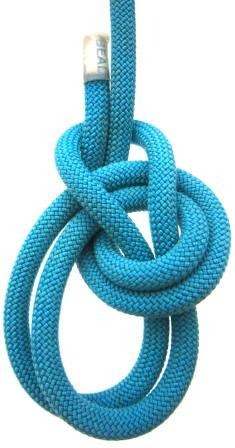
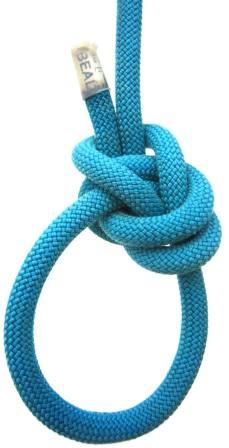
I, too, had thought of this loop some time ago, but I had dismissed it :
http://igkt.net/sm/index.php?topic=4687.0
Why ? Because, as it happens with all those knots where the Working End retraces the same path along a large part of the nub, they should be careful dressed ( so, they are not self-dressing, and they require some attention from the knot tyer ), and they can easily or accidentally be re-dressed in a non-optimum way… In particular, the Standing Part s first curve can be transformed from a wide, 3-rope-diameters one, to a narrow, 2-diameters one. In general, each individual line of a two-parallel-lines pair can easily “jump” “over” or “under” the other, can follow an inside or an outside track at each curve, etc, so the geometry of the knot can be transformed - and, in practical knots, it is the geometry which matters most.
No. The pure essence of Bowlinism is present in the TDB. Repetition of #1010 parts is not grounds for barring. Witness the Double Bowline. The same reasoning applies to the TDB. Laying sequence and handedness do not factor into the matter.
That’s the crux of the conundrum…if we don’t call them Bowline, what then do we call them? I.E. how do we name them? Well, like we would otherwise name any knot. By…
geometry
distinguishing feature
author/rediscoverer
association with established knotted forms/structures…
application…
performance characteristic…
place discovered…
time stamp…
other…
Hi alpineer,
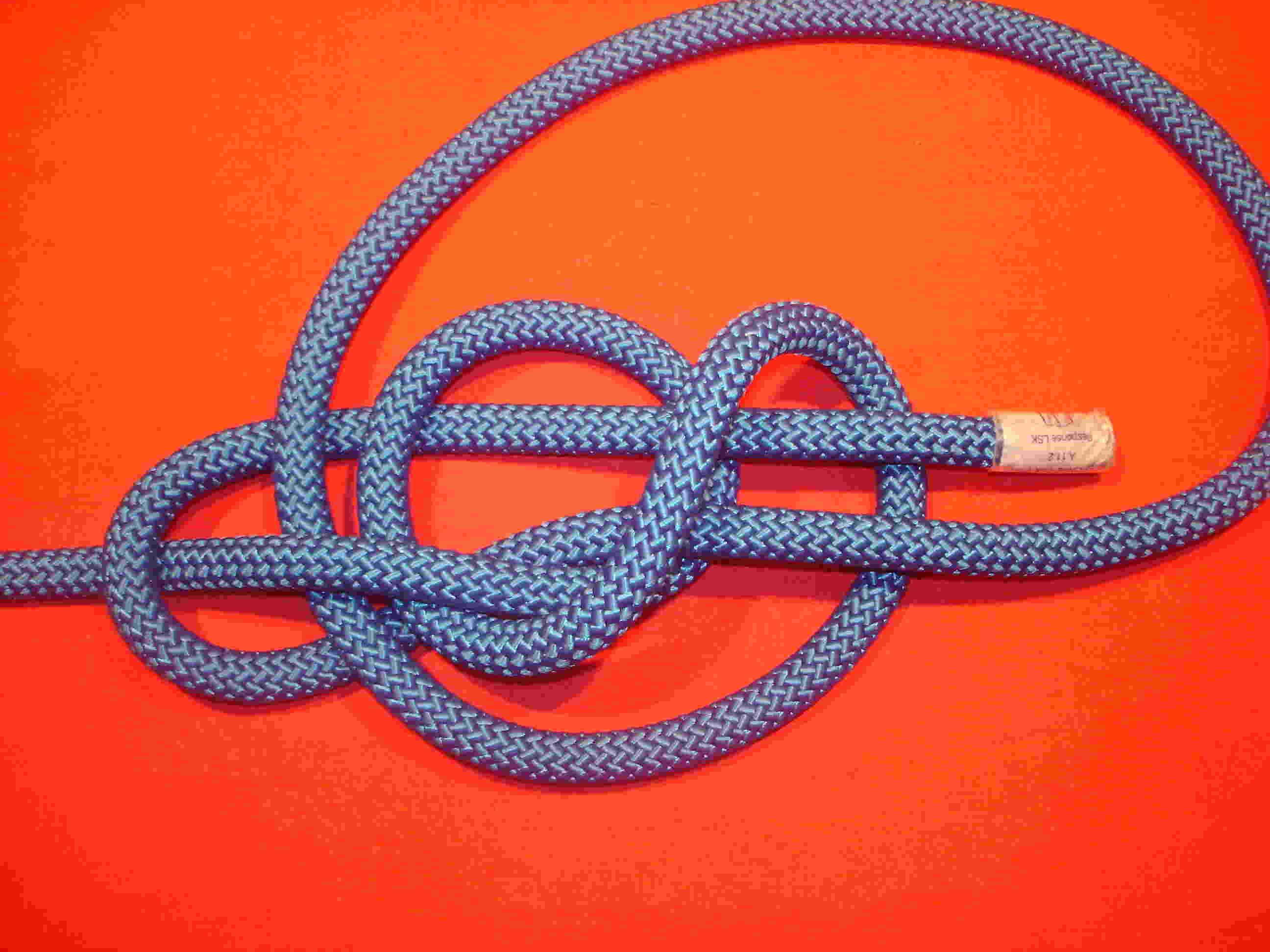
I am really unsure why the comment “Munter element excludes it from being a true Bowline” applies. When the B&B Bowline has it’s final tuck removed we have the image I give you below. To me what I see in that image is a “Munter” style Bowline: It clearly has a dual turNip (the Munter) that secures a bight shaped collar. I do not see why this is not just another dual nip bowline like the Double Bowline or the Water Bowline, for example.
The “Munter” name has come up a few times in this thread as not being deemed as a suitable core for defining a bowline, to me it is. If the image I show you is not a bowline then the so called “B&B Bowline” certainly is not. Can you explain more please about the Munter core, with particular reference to my image?
Cheers,
mobius
B&B: https://docs.google.com/presentation/d/1u_yuaYi0fOTUL_90g4yzKPbHvS29Kf0QRfnOJrbRb3s/edit?usp=sharing
Hi mobius,
The nipping structure of your knot is composed of a munter element plus a cross-stacked loop. The munter is a geometrically distinctive elemental form on it’s own and deserves to be treated as such. It diverges from what defines the pure elemental structure of the bowline. My criteria for determining whether, or not, a knot is a bowline is based purely on the geometry and inter-tanglement of elemental forms. Why do I use this criteria? Simply because I want to limit the number of knots that would be categorized as bowlines. Understand that excluding a knot from being a bowline places no judgement - good, bad, or otherwise - on it’s quality as a knot.
Now, if others want to use less defining criteria to determine bowline-ship, good luck. But be warned, the list of bowlines could grow exponentially. If you include your B&B knot on the list of bowlines then you must also include the Karash loop. Do you require all bowlines to have a bight component? If not, then you must include the Farmer’s Loop, the Carrick loops, i.e. any eye knot which has a munter element in it’s nipping structure. And it gets worse, once you’ve let the geometric “cat out of the bag” by allowing the munter. Where do you want to draw the line between what is and what isn’t a bowline. You might, therefor, decide that any eye knot having an overhand based nipping structure is a bowline. Or, you might decide that all bowlines must have a loopy nipping structure, but no requisite bight element. It’s up to you to decide. For myself, I’ve happily already decided to my satisfaction. At the end of it all, the knots are still what they are, and they do what they do, irrespective of the reasoning used to categorize them.
I am progressing this project.
I see a major stumbling block being just reaching some broad consensus on the basic terminology identifying each of the key components of the Bowline structure - if we cant even reach agreement on this simple matter - then it will be near impossible to move forward.
I have created an image of the #1010 R/hand Bowline structure - showing the anatomy per Xarax proposition.
Xarax, I have labelled the various components as per your post at reply #215. Note that I have added a comment re the ‘capstan effect’ around the ‘Standing End’. I can delete this reference if you wish.
I am requesting that all interested IGKT members label each component and then report back in this thread - so I can collate and then post each proposition.
I need 100% clarity on this - no obfuscation.
Reference your preferred names for each component against A, B, C, D, E, F, G.
I would like to keep this professional and civil - and I will ignore responses that are vitriolic or taunting toward other IGKT members (and I hope that the site moderators will swiftly delete posts that are so deserving).
I fully respect everyone’s input as supplied in good faith - and will not seek to rubbish or denigrate a contributors proposition.
I see this as the only way to progress this project - going forward.
I have added a blank (Template) .JPG image to facilitate this process…
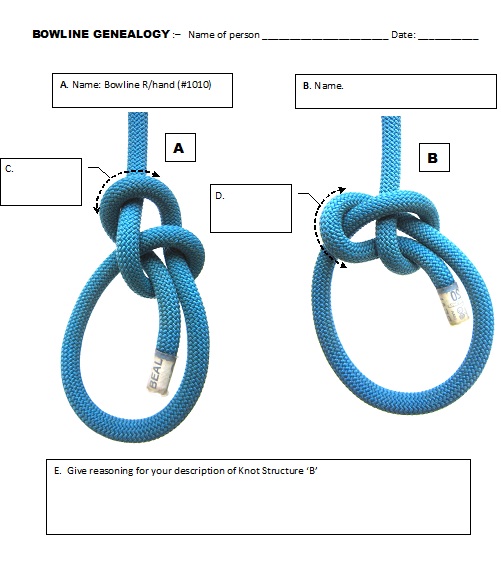
I have also added a ‘Genealogy-Template’ image - direct comparison between A and B.
Mark Gommers
EDITED: I have added a further image…Carrick loop #1033 comparison to #1010
…
Per image ‘Bowline_Anatomy_TEMPLATE’ at position ‘C’ - this needs to be well defined.
For example:
is it a ‘loop’ ?
is it a ‘nipping turn’ ?
is it a ‘nipping loop’ ?
is it a ‘gripping turn’ ?
is it a ‘nipping structure’ ?
is it a ‘circular helical nipping structure’ ?
is it a ‘constricting turn’ ?
is it a ‘collapsing turn’ ?
is it a ‘collapsing loop’ ?
And so on…
In other words - what is the different between:
Turn
Loop
Wrap
helix
circular helix
And therefore - how is the position ‘C’ defined ?
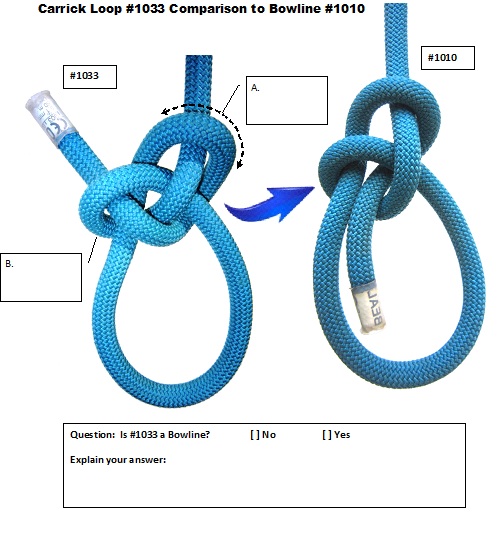
Hi alpineer,
Thank you for your response. I am not fussed whether the munter bowline (like) variation I showed before is ultimately seen as a bowline or not (or how good or bad it is). I was just trying to better understand your viewpoint.
I see form the list above (which is clearly not complete, nor was it intended to be) that The “Eskimo” Bowline is missing, presumably because it has a core nub structure that is a Munter hitch style crossing knot. The Clove, Girth/Cow, Constrictor style turNips are all missing too. The only dual turNip cores you seem to allow are the double helix ones as in the Double Bowline, EBDB, etc. Please correct me if I have misinterpreted your viewpoint.
It is all interesting and one might be tempted to go one step further and state that only a simple single helix turNip is allowed. That would get rid of a lot more bowline ‘pretenders’ ;D On top of that one could cull the potential bowline list by requiring that the bight collar, secured by the turNip, is truly a ‘U’ shape and that Myrtle (crossed), or Janus (reversed direction), style collars are not allowed ;D
I am not being very serious in that last paragraph, names like “Double Bowline”, “Water Bowline” and probably even “Eskimo Bowline” seem to me to be too entrenched in bowline history for them not to be called bowlines. I believe we just have to work with history and find the right dividing line between bowline and ‘bowline-like’ loops.
Cheers,
mobius.
Do not forget to show the crossing point, and label the legs of the collar and of the nipping loop ( “inside” the collar and the nipping loop ).
“Single helix”, is a wrong term - because when we say “single helix” we usually mean a single-stranded helix, in contrast to a double or triple stranded one.
“Single-turn helix”, or “One-turn helix”, sounds more accurate to me.
https://en.wikipedia.org/wiki/Double_helix_(disambiguation)
https://en.wikipedia.org/wiki/Triple_helix
Bowline Anatomy:
D. I would slightly prefer “Outgoing eye leg”. Outgoing seems better to me than Ongoing if it is to be often combined with “Returning eye leg” in the same discussion.
G. the term “Eye” to me refers to the whole elliptical loop shape, ie. like a human eye. I would probably use “Tip of the Eye” for that lower side of the eye or even just “Tip”.
Bowline Genealogy:
B. “Eskimo” for me. This is what I have always known it as and I do not like the alternative particularly. “Anti” at first sounded to me as though it meant that the “Eskimo” is not a bowline. Then I thought in terms of anticyclone and thought that it meant a Left Hand Bowline. “Anti” is not quite right for me.
C. “Collar” is fine for me. Shirt collars go around necks (the vertical SPart) and this is exactly what C. does.
D. “Collar” is ok too I suppose, though the outgoing leg is not exactly the neck, is it? I don’t know whether “waist band” would make better sense. Or we could talk of D. still being a “collar”, however C. is a “proper collar”
E. We could talk about this “Eskimo” Bowline as one where the collar is replaced by a waist band around the outgoing leg
Cheers,
mobius
I had thought of the word “ongoing” to hint that, at this part of the eye, it is advancing / continuing / unfolding, i.e. to denote the stage of the process in the forming of the eye.
If we do not care about this meaning, I guess we should prefer two simple words which are more direct antonyms of eachother : "arriving / departing ", " coming - going ", " entering - exiting ", etc.
It would be good if we could use the same antonyms for the legs of the collar, and for the legs of the nippping loop.
Bowline Anatomy:
A. Standing Part
B. Collar (delete capstan reference)
C. Nipping Loop (delete helix reference)
D. Standing Part Side Eye Leg
E. Tail (End is redundant)
F. Tail Side Eye Leg
G. Eye
Additional Parts…
Stem
Crossing Point
Core/Nub
To better indicate the Eye, add a short line for each eye leg coming from the core with arrows pointing back toward base of the Eye. Indicate “Eye” in box at three separate locations.
Bowline Genealogy:
C. Collar
D. Collar
E. They are both Collars, irrespective of what they are collaring.
Eskimo, Clove, Double, Water are part of the immediate Bowline family, being constructed of simple stacked loops. And I’m OK with the extra Janus collars having pure Bowline status because a) they are simple bight collars and b) they are apres bowline extensions. But the Constrictor puts an extra “twist” into the mix, adding complexity, and so is excluded from the immediate family. The Cow is in a grey zone for me and would take more keyboard pounding to elaborate why than I care to at this time. Perhaps later.