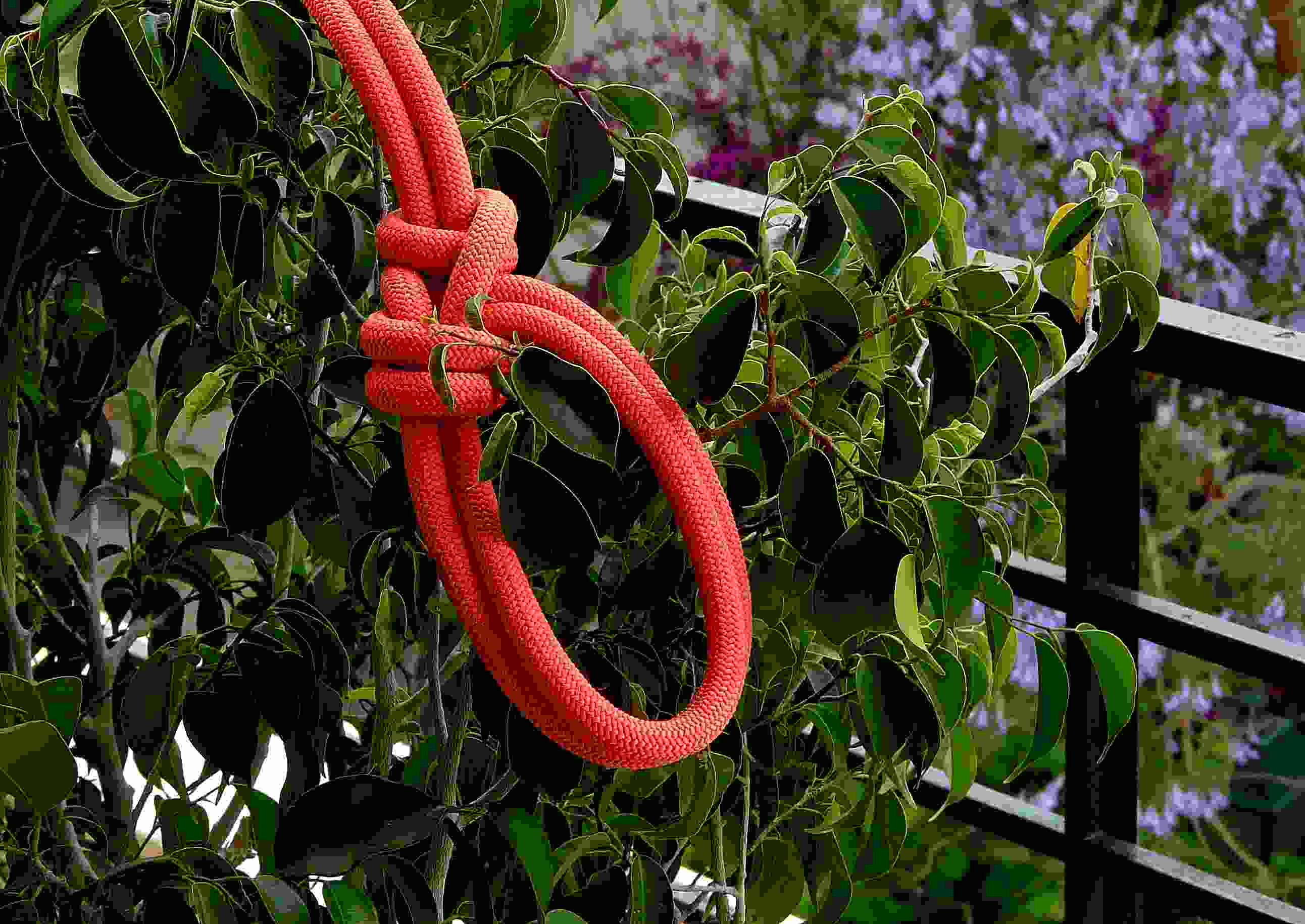
However, I do understand that this point is perhaps not so easy to understand… We had discussed it somewhere in the long thread about the bowline, but l think it would probably be better to try to explain it once more here.
The Standing End can not revolve freely around its axis, and the rim/tip of the collar = the curved segment of the rope which belongs to its U-turn around the Standing End, can not slide freely around it ! In other words, the two legs of the collar are not freely “communicating” to each other : the tension forces ( when they “enter” into the first leg of the collar - the T-Load ) do not simply change direction, but retain their initial size ( when they “exit” from the second leg of the collar - the T-Hold ). If the Standing End could revolve around its axis, or if there was no friction at the contact area between the straight segment of the Standing End, and the curved segment of the collar, the surface of Standing End would behave like a free revolving pulley, where the tension on the continuation of the returning eyeleg, at the point it enters into its curved path, would remain the same, at the point it exits from this path.
However, if there was no friction at the contact area between the Standing End and the collar, the nipping loop would had to nip and immobilize a second leg of the collar loaded exactly as heavily as the first ! ( T-Hold would had been equal to T-Load ). One of the elements which characterize the ingenious, most effective locking mechanism of the bowline, is that this does NOT happen ! The second leg of the collar is loaded more lightly than the first, so the burden which the nipping loop has to carry, in order to immobilize it, is lighter : a significant portion of the tensile forces which arrive at the end of the first leg of the collar, are absorbed by the friction between those two segments, the straight segment of the Standing End, and the curved segment of the collar. Of course, the U-turn of the common collar of the common bowline is only half a turn ( φ=180 degrees ), so the effect is not so pronounced. If we add one more turn, and form a “double-turn”=“Bull” collar ( of one-and-a-half turns, φ=540 degrees ), like the collar of the modified bowline on-the-bight shown at (1) and at the attached picture, we can see this effect more clearly.
P.S. To be more precise, the effective φ is larger, because, after it goes through the nipping loop, the continuation of the returning eyeleg first contacts and turns on the surface of the first leg of the nipping loop ( φ=45-60 degrees ), then of the Standing End s ( φ=180+ degrees ), and then of the same leg of the nipping loop s again ( φ=45-60 degrees ).
“First” and “Second” leg of the eye / collar / nipping loop, would be OK, provided people understand the denoted temporal order : when/if the bowline is tied in-the-end, the Working End arrives first at the “First” leg of whatever, and then at the “Second” leg of whaterver. ( I had used those labels in the past, but I am not sure about how people conceive them…).
“Turn” is a different thing to me, than “loop”. It denotes the shape of the curved path of a line - for example, “U-turn”, “S-turn”. For a 360 degrees to the left or to the right, I use the term “O-turn”.
“Loop” is the structural element where the line makes a U-turn ( like it happens in the collar of the common bowline ) or a O-turn ( like it happens in the nipping loop of the common bowline ).
Therefore, “nipping loop” is a constricting element of a knot, which is :
shaped like a O-turn
tensioned by both ends, more or less by the same force ( otherwise, it is a half hitch, which is tensioned by the one end - the other end is more or less immobilized )
placed around one or more penetrating lines, which are nipped by its constricting action.
“Nipping turn” is a wrong turn, because it tries to denote a SHAPE ( geometry ) that is LOADED ( dynamics ) - two things that belong to different worlds. Same for “constricting turn” and “collapsing turn” - it is better to use the term “loop” when we want to denote a structural element, and “turn” when we want to denote only its geometrical shape. For the “Turnip”, used by Dan Lehman, roo made the only usefull, to me, comment he ever made : it sounds like a vegetable.
“Circular helix”, or “circular helical” whatever, are, for what we want to describe, redundant terms. Helix, and helical whatever, are enough in our case. A circular helix has constant radius, and it is not conical ( increasing or decreasing curvature ) or elliptical. I do not know any nipping structure which is shaped like a conical or elliptical helix, so what is the purpose of adding the “circular” adjective ?
We should also keep in mind that a helix may have one or more 360 degrees helical turns. However, a helix which has two 360 degrees helical turns, is NOT a double helix ! A double helix is a compound shape, made by two helices which share the same axis, the one translated in relation to the other, and perhaps somehow narrower / wider than the other.
“Wrap” is a line which encircles an object, be it one or more segments of ropes or rods. To remain in place, it should be tensioned, so, in this, it is not much different than a nipping loop - but in the case of the “nipping loop”, what tends to move and slide through is the penetrating line or object, while in the case of the “wrap” what tends to move and slide is the wrap itself.
Personally, I had not made up my mind about the Carrick loop - its collar is a “Myrtle”-like collar : it enters into the nipping loop for the second time through the opposite side from which it had exited from ( in a “proper” collar, it enters into the nipping loop from the same side it had exited from ). However, before it enters into the nipping loop for this secnd time, it also “collars”, in a way, the ongoing / first eyeleg… This S-shaped path in between the two tensioned elements, the Standing End and the ongoing/first eyelreg, makes this Myrtle-like collar very peculiar, and perhaps the eyeknot based on it should not be labeled as a “bowline” at all.
I understood capstan to be the active driven element of a rope hauling system. Seeing the photo of the holding capstans convinced me otherwise - not you’re words, which I don’t read - that a capstan can also be passive in the sense that it doesn’t rotate, as is the case with a holding capstan. So, thanks for leading me to that photo, but I’m not sure extra descriptions are needed, or even wanted, when labeling parts of the Bowline’s anatomy, so my “delete” comment remains for that reason.
Coincidence ! My comment was meant for agent smith, too !
It could nt be for somebody which does not read, could it ?
For those who can read, and are interested in understanding before deleting, there is Wikipedia !
Great invention ! ( perhaps greater than the bowline…)
I agree with with xarax, this loop gives me trouble when deciding bowline, or “bowline-like”.
On one level I have looked at a “Myrtle” collar and thought of it as a crossed “u-bight”, therefore bowline. However the Tail of a Carrick Loop just goes on a trip before it enters the turNip again and that gives me problems.
I have much more trouble deciding the nature of a bowline based on it’s structure as derived from what the Tail does (ie. what type of bight the turNip actually secures) than the nature of the turNip itself (any single or dual turNip is ok for me).
Thinking on the run here, if we get rid of “Myrtle” style collars we solve quite a few problems. By that I mean that a bowline has to obey: The first time the Tail reenters the turNip, then it has to be from the same side it left. From my own observations, I have seen plenty of loops that appear to have a turNip, yet the Tail goes ‘walkabout’ so much before going back into the turNip that I lose all sense of it being a bowline. Often they seem to be “Myrtle” types. (Suggestion only for Mark, have not thought this one through too much).
NB : the tail CAN, and so can work as a sort of
roller bearing, which I think enables the knot
to bear cyclical loading w/o chafing, as the S.Part
pulls through --back’n’forth w/varied tension–
the not-very-tight-fitting collar, and then it
pulls/draws the tail --its initial contact part–
with it, the tail rolling, rather than rubbing across
it --hence, no chafing! (And the draw on the eye leg
of this turNip will arrest movement sooner than later,
helping to prevent back’n’forth rubbing.)
... U-turn around the Standing End, [i]can not slide freely around it[/i] !
In other words, the two legs of the collar are not freely "communicating" to each other :
the tension forces ( when they "enter" into the first leg of the collar - the T-Load )
...
However, if there was no friction at the contact area between the Standing End and the collar,
the nipping loop would had to nip and immobilize a second leg of the collar loaded exactly as heavily as the first !
( T-Hold would had been equal to T-Load ).[i] One of the elements which characterize the ingenious,
most effective locking mechanism of the bowline, is that this does NOT happen ![/i]
The second leg of the collar is loaded more lightly than the first,
so the burden which the nipping loop has to carry, in order to immobilize it, is lighter
...
This is a conjecture completely ignoring the "ingenious"
aspect of the [i]sheepshank[/i], where the same sort of bight-end
collar goes around . . . [u]nothing[/u], and yet the "first leg" being
nipped is completely adequate --and we might suppose so, too,
in the [i]bowline[/i].
.:. The second leg needs less nipping-hold because the first
leg is well nipped, not because of the U-turn around a frictive
part in their connection.
I do not know what you mean by “tail” here : The fist leg of the collar as it comes “up” and out of the nipping loop, or the rim of the collar ( the curved part which follows the U-turn ), or the second leg of the collar as it goes “down” and in the nipping loop, or the “proper” tail, the Tail End ? I hope that agent_smith will soon put an end to this broken telephone game…
What comes in contact with the Standing End, is the rim of the collar, its U-turned part. This part can not revolve freely around its axis, simply because it is curved and stiff - but also because its two ends, the two legs of the collar, can not revolve around their axes, too, because their other ends are squeezed into the nipping loop and are immobilized - and because, as I had mentioned in the P.S. of my previous post, they, too, are not straight but slightly curved segments ( they make small but not negligible 45-60 degrees turns around the the first leg of the nipping loop ).
However, I believe that I understand what you try to say - which is NOT any revolution of any segment of the collar or the tail around its own axis ( only the Standing End could revolve around its axis, if it was not attached to the nipping loop, and if it was not stiff enough ), but a rotation around another, perpendicular, axis… In a not-very-tight-fitting collar, the rim of the collar does move, indeed, following any motion of the Standing End back and forth. And this inserts new elements into the equation, because the force by which the curved segment of the collar embraces the Standing End varies, so the friction forces between those two elements vary, and this modifies the numbers which should be taken into account in the calculation of the capstan effect…
I was not talking about this. I was talking about the mechanism which is responsible for the fact ( which can easily be verified ) that the tension on the first leg of the collar ( After the nipping loop ) is smaller than the tension on the second leg of the collar ( Before the nipping loop ), so the work that the nipping loop has to do, when it nips this second leg, is easier. That fact can be “explained” ( but, of course, can not described accurately ) by the capstan effect. If we do not want or wish to use any “model” of the mechanism, we can simply say that the friction around the path the continuation of the returning eyeleg follows, in each and every point of contact or turn, absorbs a portion of the tensile forces which run through it, and so the nipping loop, at its last contact with it, has an easier job to do.
I am really surprised, that, after all those long years dealing with the bowline, you had not noticed or understood this rather elementary and obvious thing ! Unbelievable ! ( However, I suspect that you do, but you only want to say something against what I happen to say, for the sake of keyboarding ! Let it be. )
As I had pointed in a previous post ( which you had evidently not read or you had forgotten) , in the Sheepshank, and in the Gleipnir, the mechanism is simpler - the fact that those knots manage to “work”, does not mean that they “work” in the same way, or in as effectively way as in the bowline ! ! ! The proof of this, is that, in those two knots, we have tensioned lines that is either nipped at TWO points = twice ( in the Sheepshank ), or tensioned line that are twisted around each other ( inside the nipping loop ), and carry half of the load ( the famous mechanical advantage of the Gleipnir ).
Now, you can make a one-nipping-loop Sheepshank, or a one-line Gleipnir, “work”, indeed. You only need some drops of a super glue - but that effect has nothing to do with the capstan effect, so I guess I do not have to explain it.
There is NO need for the nipping of the first leg ! You can by-pass the nipping of the first leg ( by making the line pass outside the nipping loop, for example, while keeping the “balance” of the nub in mid-air in another way ), and yet immobilize the returning eyeleg more easily and completely, by the nipping of the second leg, and the second leg only. The nipping of the first leg does take place, of course, and does help in the mobilization of the eyeleg - but it is less “clever” and not as effective as the nipping of the second leg which, due to friction on the path of the line AFTER the nipping of the fist leg, is more lightly loaded - and that is why the Sheepshank needs TWO nipping loops, and the Gleipnir, ANY Gleipnir ( even those based on a very tight / almost jammed Clove hitch, or on a very tight / almost jammed overhand knot ) can not work without the friction between the TWO tails inside the nipping loop, or without utilizing the mechanical advantage offered by the TWO lines : there is no way we can prevent most or all of a strong tension which goes through a straight line to pass through a nipping loop ! That is why we have to nip it twice ( as we do in the Sheepshank ), or to distribute the tension on two lines, i.e., use a mechanical advantage, AND utilize the friction inside the nipping loop between the twisted around each other ends of those two lines ( as we do in the Gleipnir ).
ONLY after the tensile forces on the continuation of the returning eyeleg have already been diminished a lot, after those three turns around not-revolving-around-their-axes elements/“capstans” ( the first leg of the nipping loop, the base of the Standing End, and again the first leg of the nipping loop ), only then the nipping loop can nip and immobilize a heavily loaded continuation of the returning eyeleg completely. Of course, a lightly loaded eyeleg can be mobilized by any other means - including a “dumb” nipping loop, which nips it before any collar, and only once.
The collar is a fundamental element of the bowline, just because of this ! Without a collar, we have other types of eyeknots, based on tighter nipping structures, which are also secure, but not as secure as the bowline. The Pretzel loop has no collar, and it is secure, but it is no bowline !
I believe that, on a first, superficial examination, based on a very-lightly loaded bowline, one can underestimate the role of the collar. It requires the examination of a heavily-loaded bowline, to see how much the Standing End is “supporting” the curved continuation of the Standing End, which is literally “hanged” by its neck. If there were no friction along the path of the collar AFTER its first pass though the nipping loop, the bowline would had been a much less efficient knot, and it would probably require the use of more tight, “closed” nipping structures, which would had been difficult to untie.
The bowline can work, even if the first leg of the collar is not nipped ( if we “prevent” or “protect”, somehow, the first leg of the collar from the nipping action of the nipping loop ).
The bowline can not work, if only the first leg of the collar is nipped, once, and there is no friction on the line AFTER the first leg of the collar.
The bowline can not work, if only the second leg of the collar is nipped, once, and there is no friction on the line BEFORE the second leg of the collar. ( Cases 2 and 3 are equivalent ).
However, the bowline can work, if only the second leg of the collar is nipped, and there is friction on the line BEFORE this second leg, in between the first and the second legs of the collar.
To me, those 4 things say that :
1. ( If there is friction on the line between the first and the second legs of the collar )
A. the bowline can work if the second leg of the collar is nipped, but the first leg of the collar is not.
B. the bowline can not work, if the first leg of the collar is nipped, but the second leg of the collar is not. Therefore, the nipping of the second leg of the collar is more effective than the nipping of the first leg of the collar - because, ceteris paribus, the former can work without the latter, but not vice versa.
2. ( If there is no friction on the line between the first and the second leg of the collar)
C. the bowline can not work, if only one leg of the collar is nipped.
[i]Therefore, the friction between the first and the second leg of the collar is important, because, with the help of it, the bowline [u]can[/u] work in one case : the A case above[/i].
There is a simple way we can evaluate/measure how much friction is present along the path of the continuation of the returning eyeleg at the collar area, and how much this friction reduces the tension running through this line, in the segment of the Standing Part between the first and the second leg of the collar ( so, how much easier the job of the nipping loop becomes, when it nips the second collar ). We can place a ( green ) freely-rotating pulley ( a “lashing block” ) on the point shown by the black arrow, at the attached picture. Now, in order to have a stable, static knot in mechanical equilibrium, and because the two legs of the collar “ABOVE” the nipping loop are equally tensioned ( the freely rotating pulley does not only eliminate any friction at the area where the Standing End would had been in contact with the collar s U-turn, but it also plays the role of equalizer of the tension running through the two legs of the collar ), they should be equally nipped as well.
I claim that this “bowline” would be less efficient than a common bowline : moreover, it would be less efficient even from the less efficient Gleipnir, because the two penetrating the nipping loop lines are neither deflected from their straight paths nor twisted around each other, as it happens in the Gleipnir.
It is this effect of the reduction of the tensile forces along the length of the collar, that I try to "model’ with the help of the capstan effect.
Just what I wrote : “the tail” --that is, the very end part
that of all 4 parts of the eye knot is unloaded. When the
S.Part pulls hard against the normal positioning of the tail
in usual tying, it pulls the tail towards the collar a little,
in tightening the turNip --and the tail in moving
will roll with this punch, a little : surfaces that are
in contact will remain so until rolling out of contact.
(The normal loading of a mooring line probably comes
in relatively not-go-great quantities and so doesn’t
strain things beyond the comfortable circumstance
in which this simple rolling occurs.)
(This is an aspect that the tail-outside bowline lacks,
although one could position the tail so that it might
occur, anticipating the draw of the S.Part upon it.
The tensioned eye leg of course cannot rotate,
as you note.)
And yet it does, in the sheepshank and bellringer’s loop (#1147)
insofar as friction seems the issue --instead, there comes
the problem of stability/balance. You, yourself, explored this sort
of brief structure, and presented doubled nipping loop to achieve
better stability. (For the simple structure --just a bight & turNip–,
it seems that positioning the tail-end opposite the S.Part,
so the loaded tail-side of the eye lies between; if this part
is elsewhere, there seems a quicker capsizing action … .)
One might experiment by using some tubes of metal/plastic
to give “no friction” at certain points.
OK, I see what you mean. Yes, the Tail End can revolve freely around its axis, but the Standing End can not - the “model” of the bowline I had tried to paint explains the fact that there is a not negligible reduction of the amount of tension running through the line, between point A, at the start of the first leg of the collar, just after it exits from the nipping loop, and point B, at the end of the second leg of the collar, just before it enters into the nipping loop for a second time. In its path from A to B, the continuation of the returning eye leg turns around the rim of the nipping loop, then around the Standing End, and then around the rim of the nipping loop again, and in all those arcs we have friction, and absorption of tension. If in all those points the line could slide freely, or if those point belonged to freely revolving, around their axes, elements, the bowline would had been a much less efficient eyeknot. That was my point about the capstan effect - but the crux of the matter is the presence of friction at the area around the collar, which facilitates the job the nipping loop has to do regarding the second leg of the collar. ( And, of course, the reduction of the tension when the nipping loop nips the first leg of the collar also reduces the burden it has to carry when it nips the second leg of the collar, but this is obvious - what is not obvious, is that the friction AFTER the first nipping, and BEFORE the second nipping, does play an important role - and it is what makes the bowline s locking mechanism more efficient than the Gleipnir.
No, it does NOT - and the proof of that is that, in the Sheepshank, we need TWO nipping loops, and in the Gleipnir, we need some deflection, and some twisting, so additional friction, between the two tails - and even with those tricks, those knots are NOT as secure as the bowline ! Of course, under light loading, it does ( but then, as anything does, and anything goes…) - I am always speaking about heavy loading, where the locking mechanism of the bowline reveals its superiority over more simple, direct locking mechanisms, as in the cases you mention ( which can NOT withstand such loading ! )
An eyeknot based on a locking mechanism with a nipping loop but without a collar is a bowline so badly amputated, that I find it difficult to call it “bowline” any more… And by a “collar”, I do not mean a “collar-like” mid-air U turn, as the turns of the Sheepshank - AND I do not mean a “collar-like” turn around a freely revolving element ( which would behave like a freely rotating pulley or a bearing ). I mean a collar with friction - and such a collar behaves in a way which, IMHO, can be modelled, and somehow explained, by the reference to the capstan effect. Of course, the REAL situation is much more complex - but I thought that the capstan effect can explain, in a simplified yet satisfactory way, the simple fact that the second leg of the collar, when it comes out of the nipping loop, is less tensioned than the first, just before it goes into the nipping loop again.
I did, but not under the completely controlled, “laboratory” conditions I would had wished… What I had also seen, was yet another very interesting thing, which I had mentioned some time ago, in the long thread about the bowline : that the reduction of friction between the nipping loop and the one or both legs of the collar, has an unexpected effect : the nipping loop can “walk” towards the tip of the eye ! Therefore, the collar, and the friction around it, is not only needed to stabilize the nipping loop, and prevent it from opening up and degenerating into an open helix, and to reduce the tensile forces which arrive at the second leg of the collar, but also to prevent the “walking” of the nipping loop towards the tip of the eye. So much for the “secondary” role of the bowline s collar !
And it’s all nigh impossible to test empirically,
for the imbalances pointed to and necessary
countering somehow.
But the assertion “2” is just plain wrong :
necessary friction is a matter of material (you cannot
idealize this!), and we’ve seen strange things
when it’s greatly reduced via HMPE cord (and
its great strength, though IIRC the slippage comes
in sub-super force range), and can certainly know
that in the other direction (frictive) there will be
much less need of structure built upon structure.
But, yes, I’ve seen constrictor knots get loose(r)
over time, though they are well-nipped.
“2” is just plain correct, and obviously true ( and equivalent to equivalently and plainly correct and obviously true point 3., stated afterwards ) - because, otherwise, we would nt use any collar at all ! However, I believe that you simply had not understood the sentences of points “2” and “3” - perhaps because you had not noticed the word “once”, or perhaps because they are not written correctly - their meaning is unambiguous, and can not be argued…
Now, I see that the rather simple "thought experiments" ( Gedanken-experiments ) I had suggested were not, for some people, such easy things to “perform” as I had thought they would had been… OK. Then, I will try to say the same things otherwise - and in a form one can verify or falsify, with the help of a “real” experiment !
Let us tie two bowline-like knots, like the knot shown in Reply#252, and at the attached picture. In those knots, we can either use freely rotating pulleys / “lashing blocks”, to simulate the absence of friction along the line of the collar, or use not-rotating pulleys ( where the axes of the pulleys are “glued”, so the lines “feel” friction, as they slide along the grooves of the pulleys ), to simulate the presence of friction at the area of the collar.
Moreover, in each of the two cases ( the case without friction, and the case with friction ), let us do one more differentiation : let us “isolate”, from friction, the first, only, leg of the first “bowline”, and the second, only, leg of the second “bowline”, at the points where they go through the nipping loops, by the device described here :
( This “isolation” from friction inside the nipping loop may be complete or partial - in the later case, we may just reduce the friction forces around the first leg or the second leg by, say, 50%, so we would have the 100% of the “normal” friction around the one leg and the 50% around the other leg - I describe only the 100% - 0% situation, for clarity ).
So, we have FOUR different cases :
1a. No friction along the collar line - friction at the first, only, nipping point, before the first leg - no friction at the second nipping point, after the second leg.
1b. No friction along the collar line - no friction at the first nipping point, before the first leg - friction at the second, only, nipping point, after the second leg.
2a. Friction along the collar line - friction at the first, only, nipping point, before the first leg - no friction at the second nipping point, after the second leg.
2b. Friction along the collar line - no friction at the first nipping point, before the first leg - friction at the second, only, nipping point, after the second leg.
WHICH bowline-like eyeknots will hold more, in each case, in an tug-of-war type experiment ?
The evaluation I had claimed of the less efficient, secondary, “dumb” way the first leg is nipped, in comparison to the more efficient, “clever” nipping of the second leg, was based on the answer of those experiments.
1a is as efficient as 1b.
It does not matter WHERE a line is nipped, if it is nipped once, and there is no friction anywhere else !
2a slips first=less secure than 2b.
Nipping, once, only after the second leg of the collar, is more efficient / “clever” than the “dumb” nipping, once, only before the first leg of the collar.
1a slips first=less secure than 2a. 1b slips first=less secure than 2b. Friction along the first leg of the collar, along the rim of the collar, and along the second leg of the collar, does matter !
Clear as mud ? I can do no more/better !
I just scanned through to suggest adding the bowline on a bight with one loop pulled up, just to find someone beat me to it, so good.
I’ll just point out the obvious, that you don’t have to tie it that way, either TIB or in the end. You can start with the loop already short-circuited. IMO Compared to some of the creative abcdedbd bowlines it’s not a complicated retuck tied in the end even. At least you have a map in front of you and when you’re done it’s easier to verify than some double reversed-reeved pretzel hitch bowline with a yosimite finish.
Speaking of which, I’m not sure if any pretzel-nip bowline has made the list yet, for what it’s worth.
I also thought it could be nice to show the TIB method for at least the BotB and point out that basically the same method can be used to produce any number of single or double (or transformed) bowlines starting with any number of single or double nipping structures (and a simple retuck comes along for the ride). Of course it’s not a tying guide, so, maybe not…