Dan,
the Hilarious Bowline is substantially a reversed slipped Tugboat A!
Edit:
or, better, a slipped Harness Loop (Artilleryman’s Knot, ABoK#1050) (the reversed Tugboat A and the Harness Loop have the same structure).
–
The back-flipped collar is on the right in the picture (remember in my version the legs of the bight were crossed)… I should attach a better picture…
The instructions were clear!
Thank you Mark!
please, notice that you repeat the same phrases at p. 12 and p. 13.
Are you starting with H.B. then?
–and not the “immediately tucked” bight of the
variation as I presented (where the tucking goes
in the opposite direction, and the eye-tucking thus
is necessary for integrity)?!
Mark, two typos:
p.13 ln.1 “..TIB be tucking..” is “TIB by tucking” (isn’t it?)
p.16 the 'Anti Bowline? (refer to page 38)
about the TIB Bwl with strangled double overhand, is the external curve made by the tail irksome/insecure? have you considered the double overhand tied around the ongoing eye leg (with the tail towards the nub)? as I showed at reply #453 http://igkt.net/sm/index.php?topic=4480.msg38584#msg38584
Dan Lehman reported that the TIB concept most likely began circa 1987 through the work of two innovators ? John Smith
and Pieter van de Griend ? and was reported in ?Knotting Matters? issue #19.
Rather than the "TIB concept" being cited, it was the
particular bowline shown in the document newly crediting
[u]me[/u] with "Lehman's lock" --'twasn't mine (first).
(If anything, I've beat Alan to one of his locks, and
stand unique in the EBDB loop-locking --but I seek
no recognition for either (and am pretty sure that
where I got the Lee-like [i]overhand[/i] finishing lock
it was in slightly different bowlines (i.p., in a later
case, a double-eye variation, which is also [i]TIB[/i]).)
There is one new and should-be-excised “larks foot”
vice “larkshead” --let’s NOT echo the Brit’s mistake!
(p.24).
Well, I remain dismayed by the “anti-bowline” bit,
and the myriad myrtles muddle isn’t helping my
disposition.
Yesterday (2016-04-26), I came up with this conjecture: if one makes two locking loops with the tail
(aka “returning eye leg”, “working end”) through the
central nipping loop,
then ALL resulting knots --entering from either side
and turning-tucking away or towards eye,
will be okay ! --sort of a safety measure,
along the lines of tying a “back-up” offset water knot
to an initial one : that guards against all (mis)orientations
of thick-thin ropes & dressings. (Or so I’ll believe fairly
strongly until Mobius puts it to test w/his EDK-defeating
cord and proves otherwise!)
These knots will likely take a little care to set tight,
holding one looping reasonably tight while then
making the nipped & counter-nipping-in-return
looping tight within/around it,
In specificity, though, I like the anti-bowline orientation
(non-Myrtle thus) with the wrapping going towards
(note that the Myrtle wraps away from) the eye.
And position the tail’s tuck so that it sits sort of atop
the two parts bearing at the nipping loop’s crossing
point --make a sort of triangular bunch of nipped parts.
This “doubled” wrapping of the tail will give adequate
“slack security” in many materials --YMMV. (Just as I
found in one that the EBDB’s wrap simply gave out
with a little time, no matter my tight setting.)
Constant Xarax has posited that Bowlines with a Jones polynomial of 1 are TIB. In other
words, they are equivalent to the ?unknot?. But, this statement is only true for rather simple
structures, which have a crossing number smaller than 18.
THIS says exactly [i]what?![/i] of any significance?
Let’s start with “Bowlines with a …” :: please show me
some --with ANY value (1 or 2 or …). Mathematical
knots are that; bowlines are practical knots not closed
circles (and NB closing #1010 requires making a choice
of directions and resulting math. knots!).
And were it true --well, by definition the UnKnot is TIB and is what the JP of “1” means–,
how can that be constrained by number of crossings?
–if one can get it (the “1”) from however-many-crossed
a knot you have, then … BINGO!
???
This smells like a bad product promotion in a movie;
it ads nothing but puzzlement to the document.
Bowlines analysis VER 2.6b (01 May 2016) has been uploaded.
All password restrictions have been removed.
knotsaver, I have corrected the typos…
Dan, I have removed the reference to 18 or less knot crossings.
I have also done some more work to fix and improve the section of TIB Bowlines. Also changed the wording on the origins of TIB…
Some changes to the intro pages have been made.
Lehman lock Bowline has new wording added.
Dan, the concept of Anti Myrtles will remain as is for now. It fits with the overall theory - so changing ‘anti-Myrtle’ would have an impact on the overall concept of ‘Anti’. If you really have major concerns with the whole concept of ‘Anti’ - I would would need to see a full draft wording from you outlining your latest theories…
Other than that, hopefully the paper is of acceptable quality now?
VER 2.7a is now ready for download from the PACI website.
Also added Xarax’s Ampersand Bowline.
Comments are still welcome…
Mark G
EDIT NOTE: Now VER 2.7a … expanded some final thoughts about Scott’s locked Bowline. Having giving the matter some considerable thought, I feel this structure is a strong contender for the overall prize of simplicity and effectiveness. Also added further info about historical use of Bowlines in early mountaineering (in particular Portuguese Bowline #1072) - because it had the advantage of being able to wrap a few extra turns around the body to pad it out - before safety harnesses were introduced).
I think this is the last modification to the paper for a while. I feel it is complete and worthy of presentation to the IGKT!
Hi All,
I know “Lehman’s lock” EBDB loop-locking.
Can anyone please tell me what is the knot here- “(and am pretty sure that where I got the Lee-like overhand finishing lock
it was in slightly different bowlines (i.p., in a later case, a double-eye variation, which is also TIB).)”
谢谢 alanlee.
One can see an invitation to such a finish in the venerable bowline on a bight :: take the unloaded tail and tuck
it back out through the central nipping loop, which thus
makes an overhand knot structure. (It might be better
done in this case with the strand of the twin parts that will
be pressed into by its loaded twin!? Of Mark’s paper’s image
on p.41, one would reverse his tail/SPart relation, thus.)
Hi All,
I have a few pictures here, just to make it easy for our reader.
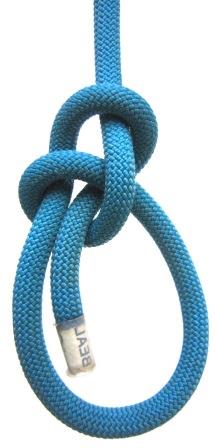
    First picture, hopefully I read it right, Bowline on the bight is safe enough for what it suppose to do.
    As Dan suggest, I don't think is worth it, by adding more tuck, you are creating more work and also the
    unnecessary part , just over kill it  and you don't gain much.

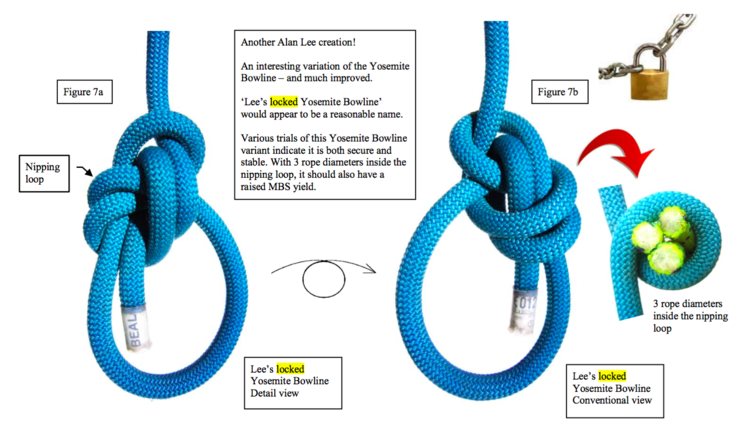
    Second and third pictures is "Lee's locked Yosemite Bowline" on (Mark's paper's image on p.46)
     谢谢 alanlee.
Firstly, you OVERead it right --you go too far by bringing
the yellow tail fully around those parts and back out through
the collar. Rather, I would (1) use the white side/position,
and (2) just do the tuck at issue VICE going out of the collar.
And this does give one the gain of having this locking structure
to tighten, which otherwise the knot does NOT have (maybe
if you “SS369” it and haul the collar(s) down tight upon
the SParts, and tighten all 'round; but this will not be done! )
But, even what you show will give such tightened security-when-slack,
unlike the original. (It gives an “end-bound” tightening.)
Changelog:
updated page 1
main image on page 7 has been changed - and i think improved (took me a while but hopefully its better than before)…see image below for concept.
page 8 now amplifies that most images are loosely tied with deliberate short tails
swapped position of Bowline on-the-bight
conclusion has been re-written…Alan Lee’s ‘link’ Bowline now featured
no change to section on anti-Bowlines / and ‘Myrtles’…unless Dan Lehman is prepared to send me copy of his analysis - and if so, I could insert it into the paper
I disagree with the “loosely tied” : SOME of the knots are so,
but many are pretty well tied. .:. I’d soften this assertion,
as one doesn’t want to imply that folks should SS369 their
knots --i.e., haul hard on the tail and crunch a sharp bend
into the SPart.
Well, yes :: look at your nice presentation (p.30) of the
common knot under various loadings --presumably you
begin as shown and don’t count that at too loose. Well,
most of what is in the paper is of that sort of setting,
right?! (Firm cordage often begets some looseness.)
Comments welcome
Dang sad to see after X's & my strong urging
that so many --most-- of the knots are shown
from the WRONG side, which the paper does
admit hides important info. Now, for some of
them --i.p., my [i]mirrored bwl[/i]-- that might
be a good thing, with a sufficient "preponderance
of evidence" showing things write (the [i]m.b.[/i]
benefits in showing that back'n'forth tucking of
its tail.
“Lark’s foot” is a British misnomer, which the late
knot researcher Bob Thrun attributed (as likely)
to a book by Bill March (he did a few). “Lark’s
HEAD” is prior and otherwise substantiated,
i.p. by noting the French term.
Whoa, calling p.23’s huge-collared knot “stable”
is beyond the pale off base --that thing can collapse,
YMMV on cordage (lesser looseness has seen capsizing).
I have noted some yachting knots quite loose like this,
but it’s hardly the thing to assert is in any reasonable
way assuredly so. (Granted, this too is my opinion
of the sheepshank, which has some kind of history
of usage apparently devoid bad results; but don’t expect
me to depend upon it (though I have in fact tried out my
fears in shortening rope working my stressing pulley,
and so far am okay).
Re p.38 knots,
PUT A 2ND LOOP-TUCK OF TAIL IN BOTH,
and they both become stable (and with an
extra dia. of rope in the nipping zone).
Changelog:
fixed a few minor grammer / typo errors throughout the paper
amended page 8 per Dan Lehmans assertions about the number of ‘loosely’ tied knots
improved Janus Bowline images on page 53
Per Dan Lehmans comment re depicting the ‘detail view’ versus ‘conventional view’…
Dang sad to see after X's & my strong urging
that so many --most-- of the knots are shown
from the WRONG side, which the paper does
admit hides important info.
I am of the view that this paper does spend enough time emphasizing the detail view - not sure how much farther one can go in the paper…? Is is not good enough in your view? Specifically which pages do you believe need to be amended (and which photos)?
Dan Lehman comment about TIB yosemite Bowline…
nb : YoBwl is also TIB.
Not sure about this point…The #1010 derived Yosemite Bowline was already shown as being TIB.
Dan Lehman remark about page 23…
Whoa, calling p.23's huge-collared knot "stable"
is beyond the pale off base --that thing can collapse,
YMMV on cordage
No comprendy…what image is being declared ‘stable’ on page 23? Which version of the Bowlines paper are you reviewing?
Am confused…
Well, the initial and some following pp have stoopid
view, not the Right One! --along w/many others.
At one point, I thought that most images were Right’d
& not Stoopid’d.
Dan Lehman comment about TIB yosemite Bowline...
nb : YoBwl is also TIB.
Not sure about this point…The #1010 derived Yosemite Bowline was already shown as being TIB.
Okay, good --sorry I just quick-read and missed … .
I suspect that most climbers don’t know this.
(though it might not do much for them if they did)
Dan Lehman remark about page 23...
Whoa, calling p.23's huge-collared knot "stable"
is beyond the pale off base --that thing can collapse,
YMMV on cordage
No comprendy…what image is being declared ‘stable’ on page 23?
Which version of the Bowlines paper are you reviewing?
Am confused…
The center image with BIG collar has this box’d comment:
“The nipping loop remains stable because the collar
is prevented from folding down.”
Well, not so surely in many circumstances, though
well enuff for some show’n’tell maybe, But it gives
the wrong impression, IMO.
Now, for some dates of interest, maybe. Lee’s Link Bwl is my #20020301f10:22,
and #2—b22 = similar with returning eye leg’s
loop opp.-handed. (AND both w/o the final
Yosemite tuck through the collar.)
(Oddly, my EBDB appears on a page of bwls.
dated 200204… but w/o date-stamping of its
own, and hardly a murmur of appreciation!?
–a note page of origin elsewhere might show
more. (I don’t have an easily searchable batch
of illustrations!)
)
And the Lehman8 --a decent tie-in for those
wanting Fig.8 body w/bowlinesque easier untying
is date-stamped/ID’d #1991-05-19 approximately.