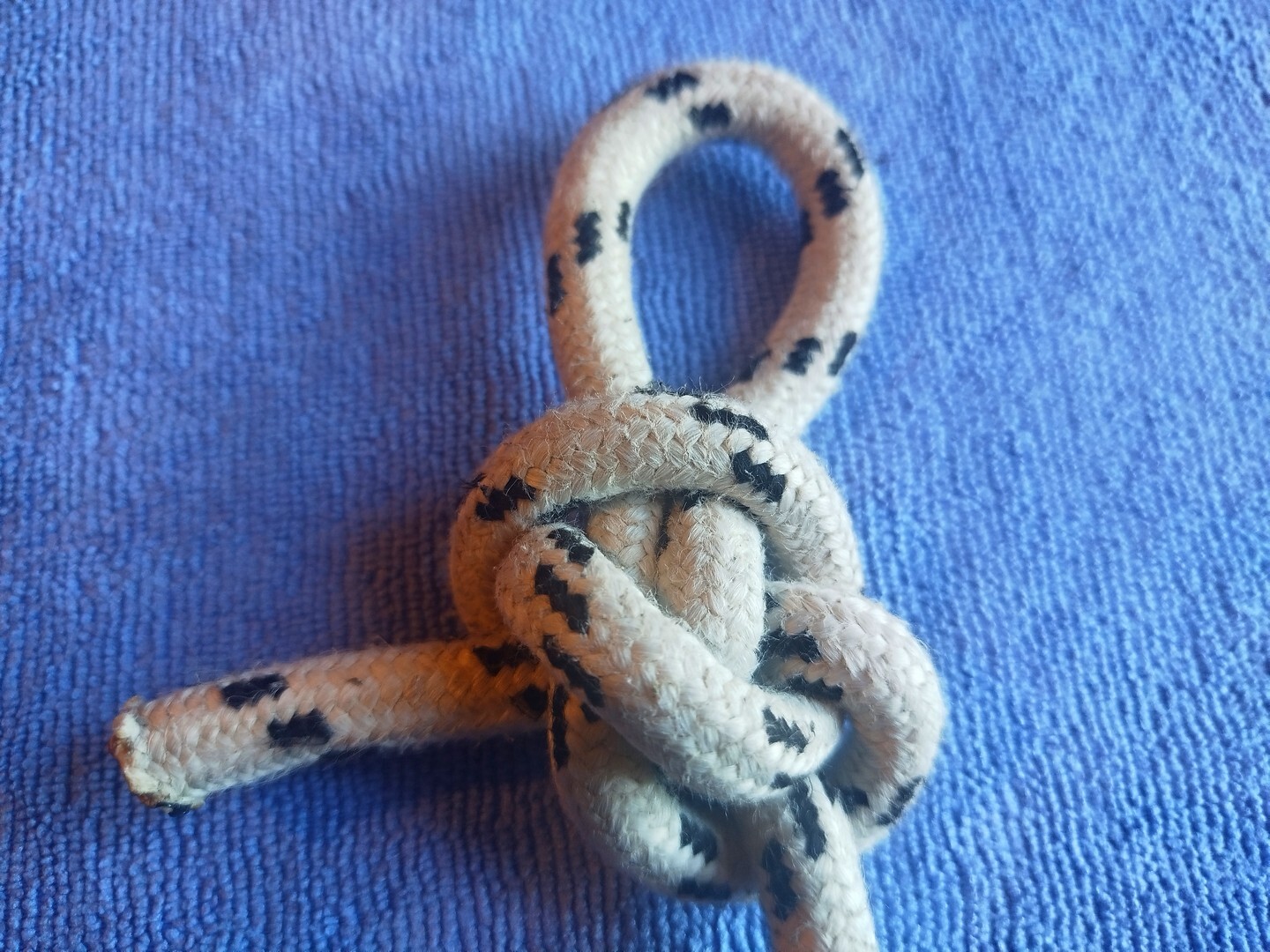
I shall start with a new bowline “on the block” until, of course proven otherwise, that belongs to the janus school of thought (see Ampersand), whose basic principle of returning structure’s operation goes like this…
First construct the bowline collar.
Then clone it by capturing the out-going leg.
Last secure the tail with some maneuver, e.g. through nipping loop.
The knot, obviously, is very close to the ampersand design, the best available bowline in my view, at least in its first four construction stages.
From the detail view of a bowline knot, the first two common stages are apparently the conventional collar formation, next is the out going eye leg capture, and last, tail threading under SP.
They just differ in the last two stages, whereon the ampersand secures the tail by threrading it over itself and down through the nipping loop, in between the collar structure legs, while this one, funnels the tug end under itself and back through the collar, retaining the tibness and an unknotted returning line of shaped 8 .
As shown, besides the lack of third rope diameter inside the nipping loop, the amount of friction, is sufficient enough for me to declare it as inherently secure.
It’s also quite possible that it follows ampersand’s response at heavy loading due to structure similarities.
What’s in store, is a TIB tying method, starting from low level, basic TIB objects, with gradual progression to more sophisticated TIB structures.
Starting out from the basic TIB core of flash bowline, i shall put into operation a rather new method of tying, which is tailored to a midline formation.
First image illustrates the scheme, left bight, central bight, S loop from left to right.
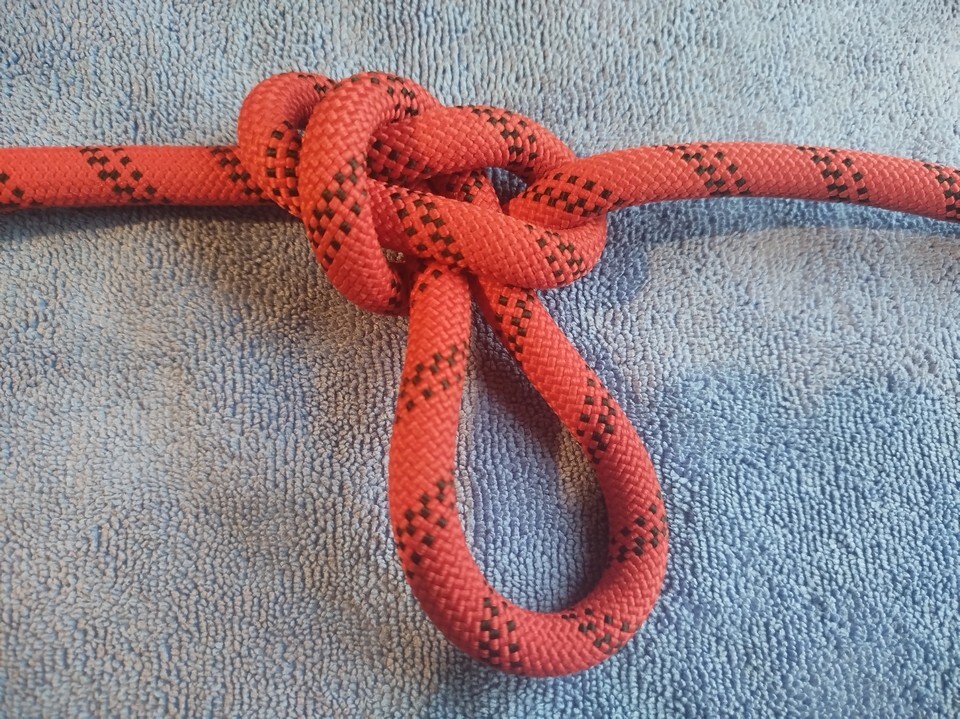
Feed the right S loop down through the left bight as shown in second image (caution: the loop through the bight and not the bight through the loop as usually).
Feed the central bight down through the loop from the previous step and there you have the flash bowline of third image.
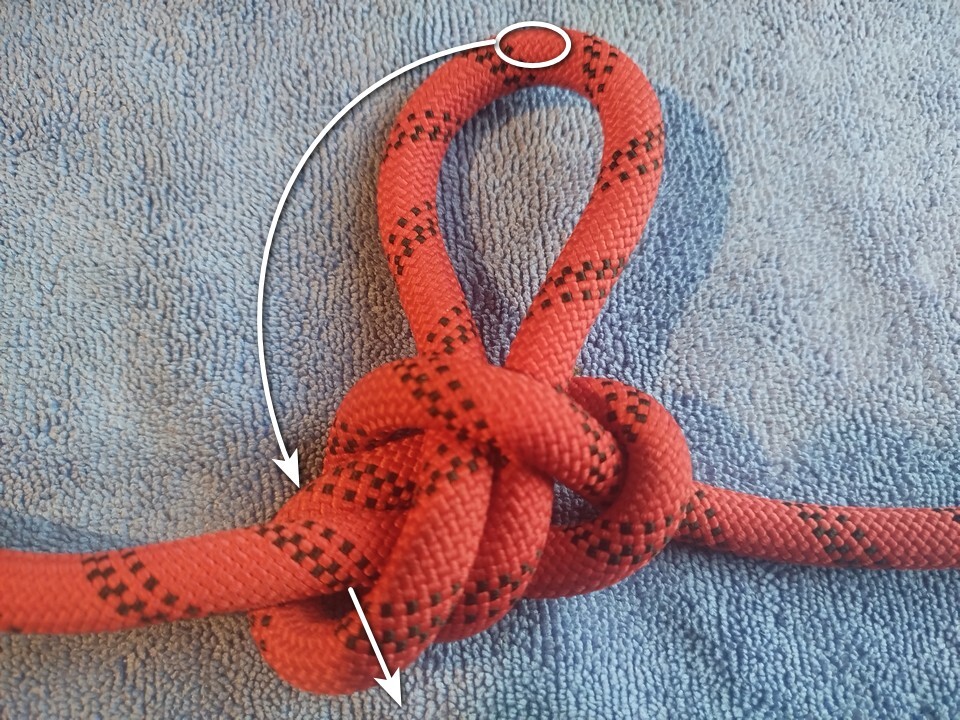
Thread the eye through the turn as indicated by the white arrow of fourth image.
This maneuver creates a variation of 1054 farmer’s loop with an overhand component.
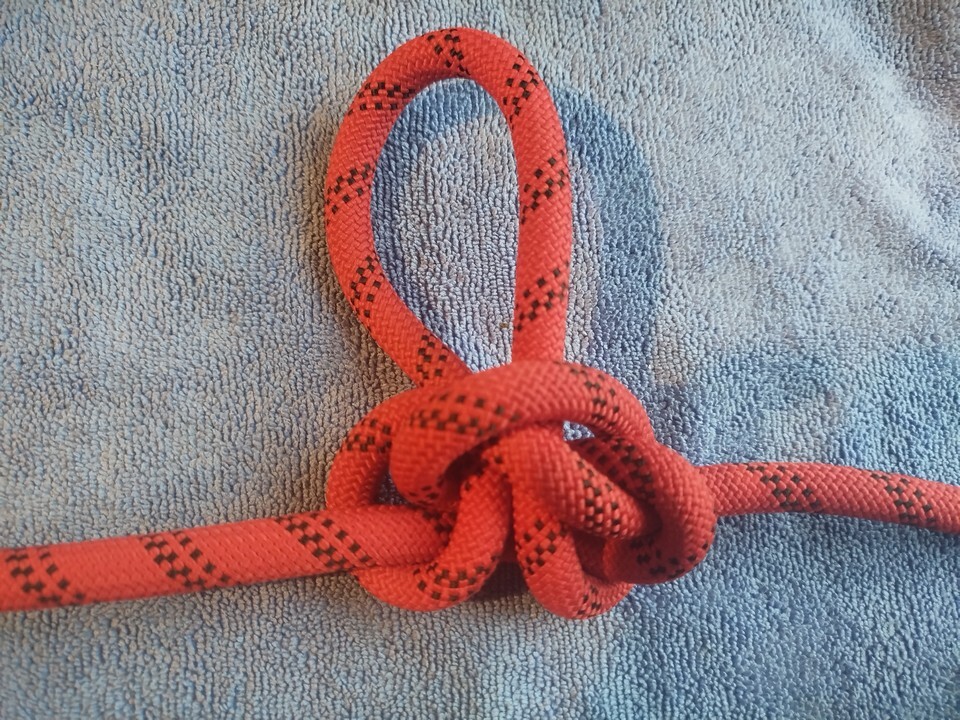
The overhand component is essential because within the process of collapsing the eye by the " fold and pull up through" action, this very overhand is transformed to the nipping loop of the bowline.
Now folding the eye from the other side of fourth image knot in previous reply, and pulling the overhand continuation line, up through the eye, which now becomes the new bowline collar, the overhand breaks down to a nipping loop and the DHB bowline takes form.
This is another approach of TIB tying manuevering, starting from low level cores and progressing to more synthesized forms employing eye or collar collapsing rather than haltering the collar (passing the eye through the collar).
There comes the, “in doubt”, necessity of having to preform flash bowline, as a precursor core of 1054 farmer’s loop variation with the overhand component.
It is already known, that every intervening knot, features its own TIB tying method, leading faster to the finishing knot, but sometimes it is good practice to start from low level parent cores and then progress to their synthesized derivatives.
I have already shown in another thread, a TIB method for 1054, which i have slightly adjusted here, in order to get the overhand component of farmer’s loop.
The S loop of third stage, is just replaced with a Z loop, as shown in the attached images.
If the knots had been worked in the end of line field, in the exact way shown previously, another decent bowline would had been derived from this TIB process.
The attached photos illustrate the corresponding stages.
I hold the distinct impression that the bowline of fourth image, is rather familiar to Knotsaver or Alan Lee, or at least very close to the instance that was presented here…
I had to try out the enhanced bowline in the first post as a bend for two ropes of different sizes. I have to admit that I had not tried this with any of the Janus Bowlines or the Ampersand Bowline. When I tried all of these, I actually liked the version posted here (which is labeled as being Janus-type) better than the others when used as a bend.
Here is what it looks like, but there is no need for the TIB tying method when it is used as a bend.
Hello Dennis thank you for your contribution and feedback.
I really like your work with bowlines tied as bends, i guess there is no bowline you have missed transforming it to its corresponding bend topology.
I would like to add some adjunctive comments about this concept.
I hold the impression that the lower sheet bend structure of first image, is more stable and stronger than the upper one.
On this basis, should we form all enhanced bowline bends in cowboy orientation?
Eyeknots derived from symmetrical bends do not work as good as their parent bends (see zeppelin bend, loop).
By the same token, asymmetrical bends coming from bowlines, are theoretically inferior compared to the functionality of their parent bowlines (the nipping loop link, is fundamentally weaker than the other which is usually more complex, plus the nipping loop is not loaded from both ends).
Of course, that does not block us from our exploration, and if we could even approach the functionality of symmetrical structures, it would be great to be able to use our beloved bowline knots as rope joints.
You are quite right, there is no need for TIB method for the bends, so how about not tucking the complex end back through the collar, in order to remove some bulk and get more compact forms?
No security issue, i guess, omitting this maneuver(second image).
Have a look at the next three derivatives, in cowboy style, as mentioned previously.
Clifford Ashley disagrees with your claim number 1. " I hold the impression that the lower sheet bend structure of first image, is more stable and stronger than the upper one." See p. 73 for the results of his test. Still even he found this seemed to violate general “principles.” See items #66, 67 on p. 16. He mentions that Cyrus Day found little difference. In scout work, I always try to tie and illustrate the upper one (#66). But I do not count a scout as wrong if he (or she now) ties the lower one (#67). The labeling of this second knot as a Left-Hand Sheet Bend is unfortunate because it seems to inflict a negative context on being left-handed. Maybe we can call it a Cowboy Sheet Bend.
I do agree that when switching to a bend, the Cowboy way of forming the collar might be an advantage. Still, I have not done any testing. As Ashley’s tests show, this might surprise us, and this might greatly depend on the rope we choose to use. When you use different ropes in the bend, not only does the size matter, but the two ropes can have very different stiffness and slickness of the surface. Thus, we may need many different bends to try!
I tried to tie all of your examples with different-sized ropes, and they all seemed to work nicely.
Thank you for your valuable, corrective intervention, i concede that i had not retained in my memory the results of Ashley’s experiment, i have no reason at all to bring them into question.
I guess i have to admit the nipping action efficiency of the right hand version, even with this slight difference according to Cyrus Day, so i reckon you are doing well teaching the conventional right hand configuration.
However, in this specific case of the cowboy variant, it would be discernibly feasible to enhance knot’s security with the additional maneuver of tucking the tail back through the collar, just by following the TIB pattern of the parent eyeknot (image 1).
Moreover, the advantage of the TIB forms, is that they can be tied in at least two modes, e.g. with the ends parallel, side by side as they exit from the knot’s core (image 2).
I won’t take the plunge this time to declare which one is stronger or more robust, but i reckon they are better, in terms of security, compared to the conventional cowboy sheet bend.
Here is a TIB exercise, aimed at the deeply initiated enthusiasts of TIB tying techniques (TIBERS ), or anyone else interested , most suitable for this thread.
Transition from low level Abok#1050 harness to a synthesized form of an Ampersand bowline or vice versa, provided that ……
Unknotted line is not allowed.
Nooses are not also allowed , only fixed eyeknots through all transformation stages.
If nooses were allowed, then the problem would be easily solved, as the ampersand bwl can be very easily morphed into a noose by pulling the returning eye leg collar continuation and collapsing the eye, while the 1050 harness knot can also be reduced to a noose in two quick stages, therefore, working in the fixed eyeknot field, makes the task quite more challenging.
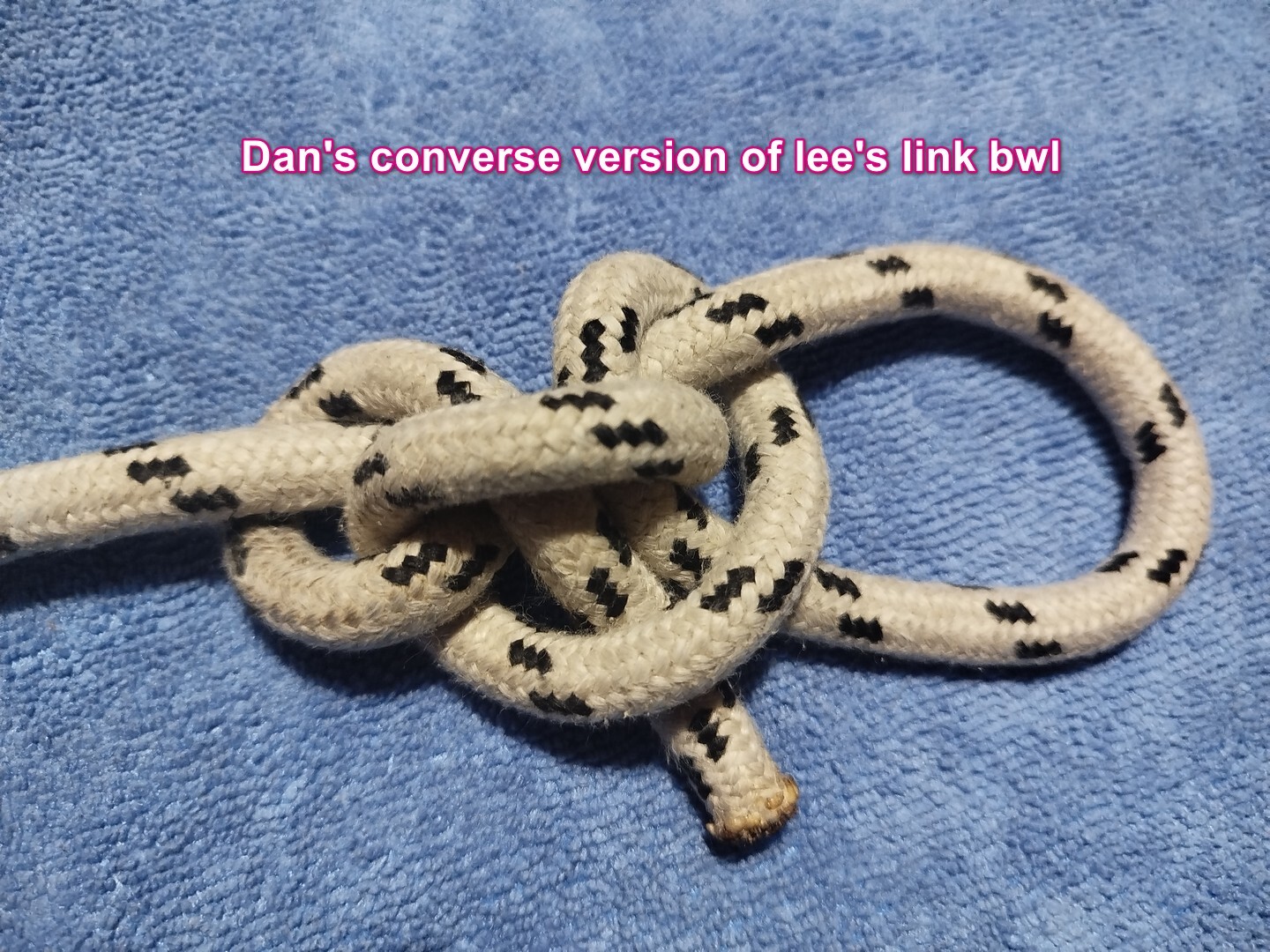
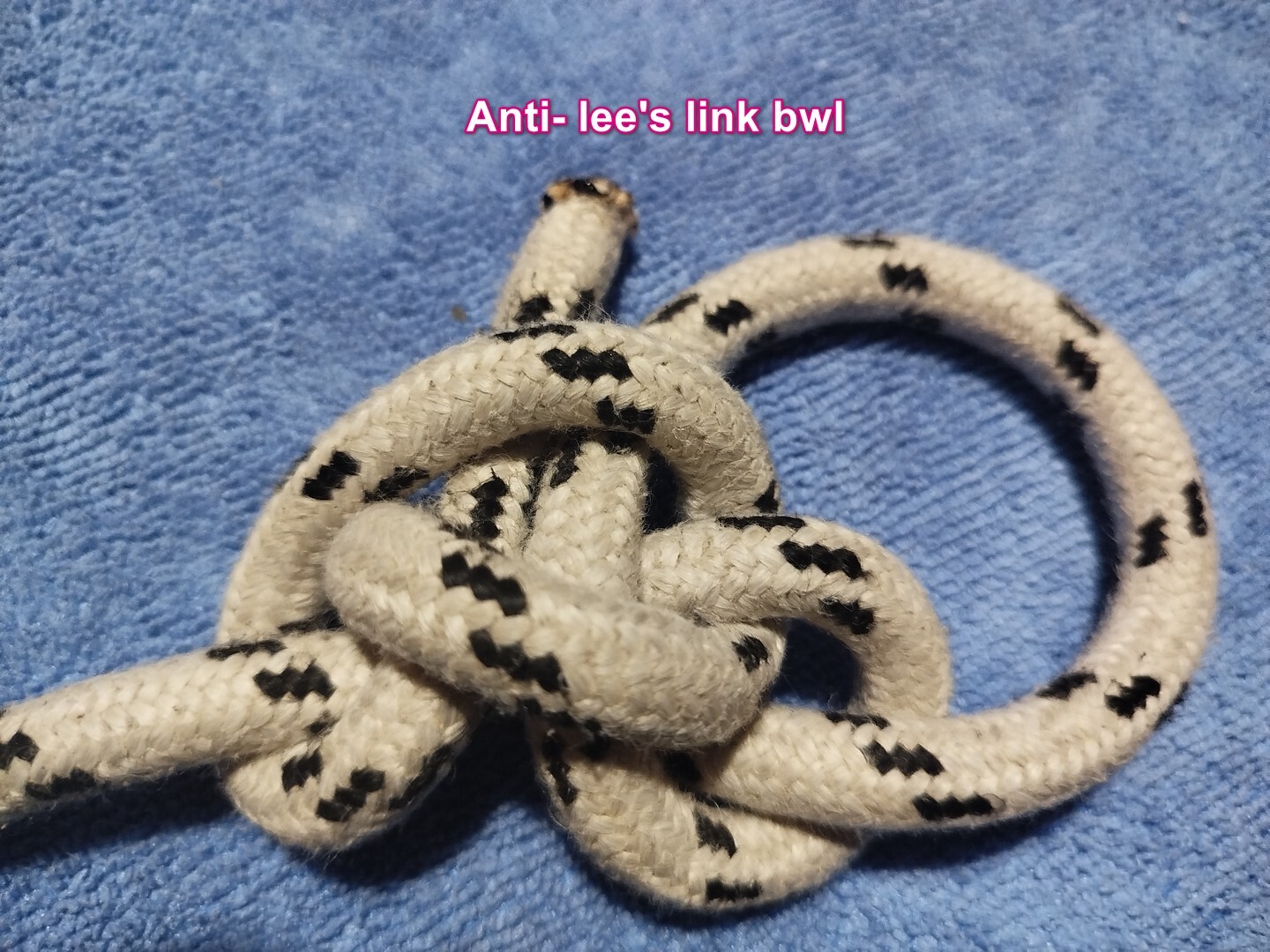
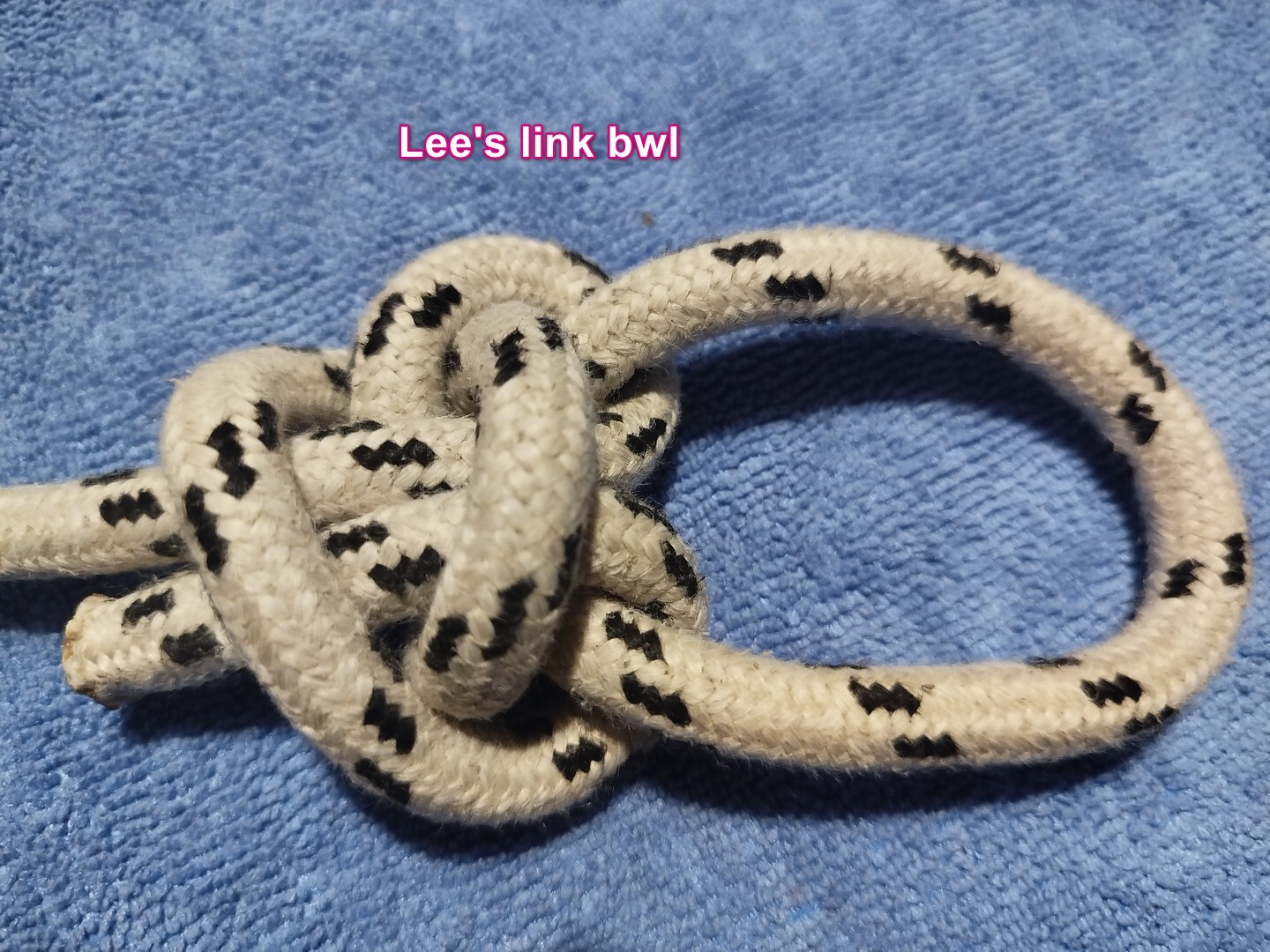
Lee's Link Bwl can be seen as what I'm now calling
the "converse" of the Doubly HAH! Bwl, sharing the
same 2-Tangle of strands 1-2 & A-B. S.Part "1" flows
into Outgoing Eye Leg "2" which stands in opposition
(force-wise) to "1" along with Returning Eye Leg "A";
"B" is the unloaded tail.
I'm (currently, 'til I run aground ...) calling the converse
of an EK as swapping IDs "1" & "A", "2" & "B", with the
same nominal EK loading of 1-v-2+A, B unloaded,
of the same but re-labeled tangle.
Which new "knot" is part of what I call "Fore<=>Afting"
--joining the original unconnected ends (Tail & S.Part)
to oppose either of the former Eye Legs. cut free.
Lee's Link has a "simplicity" --the nipping loop--
completed with a complexity (the REL's path
to the Tail); Dlby.HAH! has this complexity finished
with the simplicity. (As a tie-in EK, at a high level
one might prefer that the completion not be so
simple --harder to come loose, etc..)
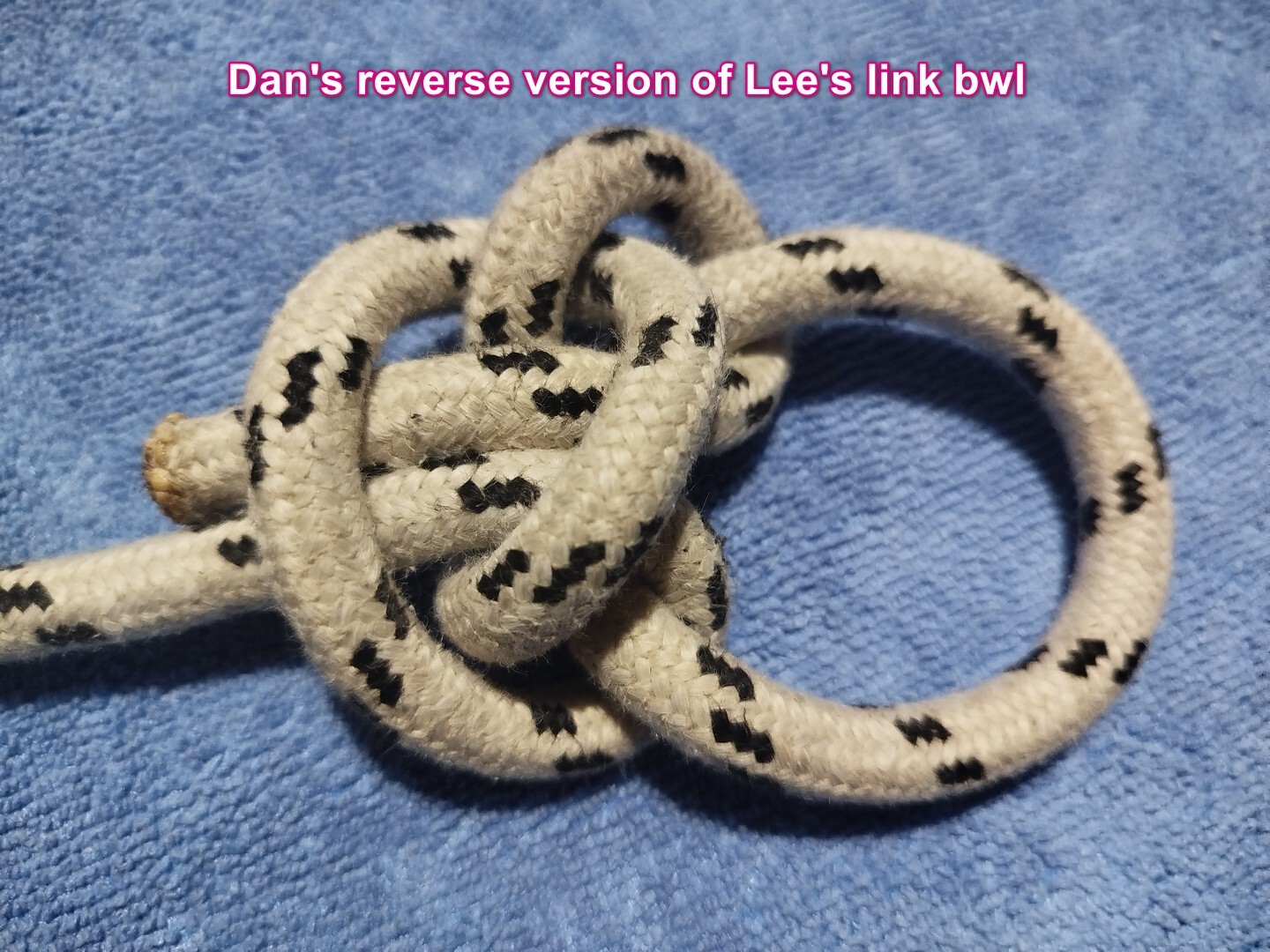
Now, these are just two of the eight definable
EKs coming from a 2-Tangle. The Reverse I see
as 2-v-1+B, A=Tail (each strand swaps the loading
of its ends (e.g., the 100% loaded S.Part becomes
50% loaded as its other end, OELeg assumes 100%,
and Tail takes on the other 50% in opposition,
orig.RELeg going to 0%.
Hello Dan, I think i know which knot you are referring to, but unfortunately i don't have a picture of it at the moment.
Actually, i was referring to the TIB loading profile of lee's link bwl, because i wanted to establish a TIB corellation with Abok#1050 harness loop, and it can be done in just two stages very easily.
The knot you are describing above is not TIB, but i bet you maintain some concerns about the jamming profile when you are loading the knot from the more complex side. Alright, the returning structure( nipping loop), is interweaved through the nipping structure in such a way that blocks some energy from diffusing through the collar, which cinches from the out going eyeleg, but nonetheless it appears to be vulnerable in heavy stress conditions.
If i may add, Alan in some of his tests, was having hard time to loosen the link segment of his bwl with his strong hands, so try to imagine the situation, if this very link was loaded directly.
However, whoever thinks that a returning loop stabilizator is insufficient and does not meet the security standards in your configuration, let him analyze the stucture once again, and acknowledge all the lines of defence against slippage.
Ι believe, it doesn't get any safer if one uses more complex returning structures at least in this paradigm.
Oh, it IS NSE --as is Lee's Link. (Indeed, I find it nigh
impossible to tie DblyHAH! by reeving : the complexity
must be formed around air awaiting the REL's part
to come stitch it together (albeit with a simple path).)
The knots come from the same Tangle.
But not all of the 8 EKs of this Tangle are NSE.
(mused names per EK so far are ::
1 -v-2+A (B) Reference
B-v-A+2 (1) Tail-Loaded
2 -v-1+B (A) Reverse (each strand's ends swap loads)
2 -v-1+A (B) Reverse Start
A-v-B+1 (2) Converse
1-v-2+B (A) Reverse Finish
(leaving out A-v-B+2 (1) & B-v-A+1 (2), yet to be named)
... and then I find myself combining relations,
ReverseFinishing the Converse, e.g.; I'd kinda wanted
to have pure/untainted references to the Reference EK.
As for jamming, both of these should be non-jamming.
--dl*
====
(edit to add "Reverse Start", & yet-unnamed knots)
I have already posted two TIB exercises, regarding the transition from Abok#1050 harness to ampersand and Lee's link bwl respectively.
Since the first one demands an extensive sequence of photos of all the intervening stages, i will leave it unanswered as a project for the interested readers, and proceed to the solution of the second one which is way simpler.
From harness to lee's link bwl
We need to achieve the following dressing state of 1050 by flipping the nipping loop and rearrange the eye legs appropriately (linear).
The harness eye should be reeved as illustrated in the following image (back side of harness dressing state), to transition to a second order, inline knot (non-linear).
For the Doubly HAH! (<= "Happy As Harry (Asher)!")**,
going around this tangle's ends from the True North point,
we sketch of the two "Fore<=>Aft'ing" knots (which I'm
calling the Reverse & the Converse) the latter, and going
clockwise, the RELeg at NE roughly becomes the S.Part;
and the OELeg below, roughly SE, becomes the Tail;
and swinging further clockwise up to the twin ends
at due West, the lower becomes the RELeg and the
upper the OELeg.
(So, while in my "Reverse" the two strands swap their
ends' weightings (so keep the S.Part strand as that
but now w/the 100% force on end "2" vs "1"; and so
the REL<->Tail strand exchanges its 50% & 0%,
the Converse changes which strand has the S.Part,
et cetera.
Here then are two of the eight EKs from this tangle
("of a simplicity & complexity").
The DblyHAH! is perhaps usable qua mid-line EK,
loadable by S.Part or Tail and through-loaded with
these ends in opposition.
(-;
** Harry Asher often expressed joy at finding a
"new knot", and dismay if it turned out not so new.
Although i'm not great at understanding verbal descriptions and i am usually struggling to follow your tying instructions, i must say that was an excellent knot description sir.
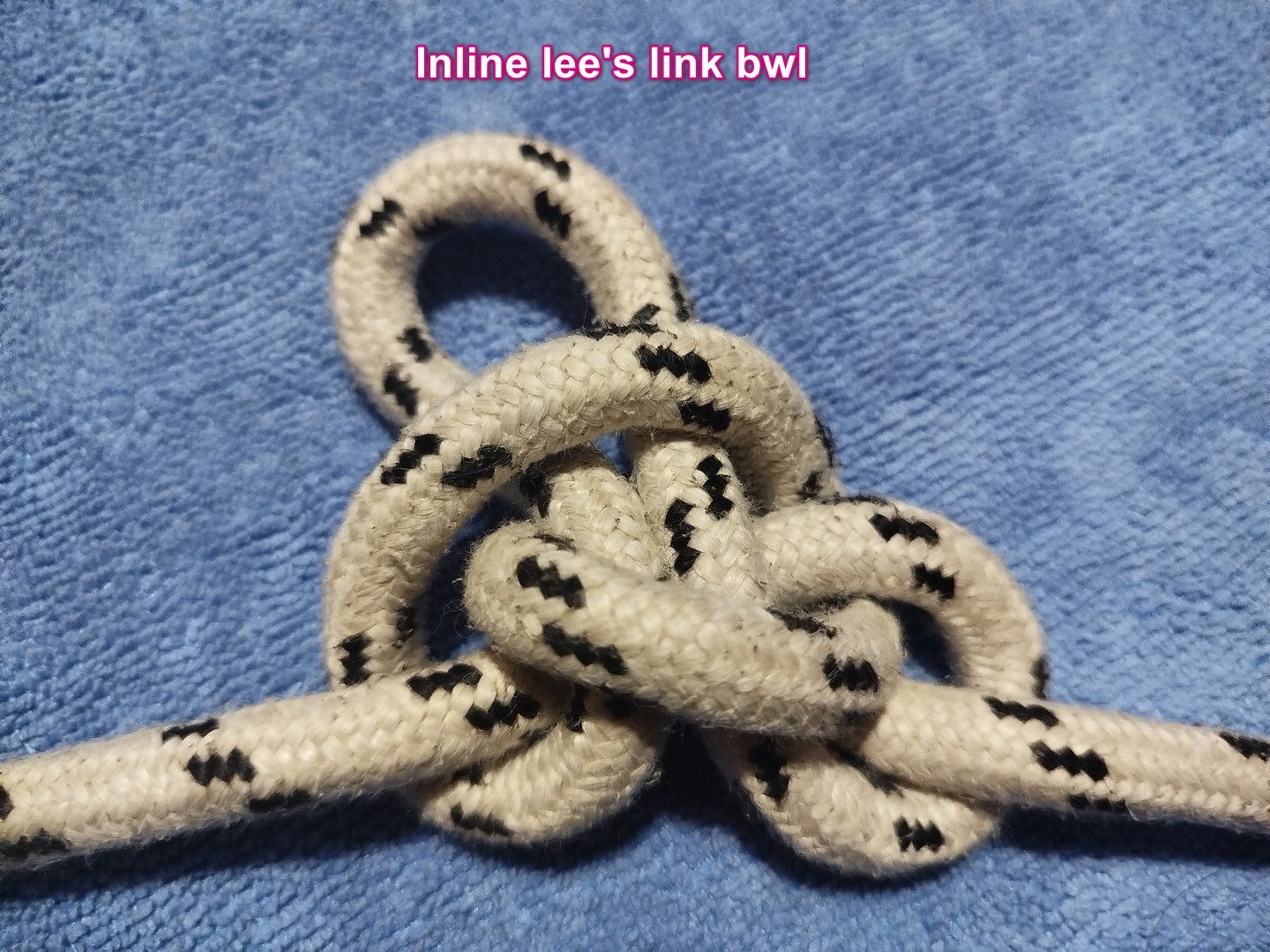
However, i was not so "Happy as Harry" when i first tied the inline variant of Lee's link bwl, because i had already seen the original prototype of Mr.Lee.
Of course they are different knots, or even better, different loading profiles of the same core.
I had already figured out which knot you were refering to ( with the term converse) from your second to last post .
The knot illustrations are in loose form with parallel ends (not crossed) for visibility reasons.
The inline profile (number 4) is supposed to be "two in one", depending on which SP side the loading is performed.
In terms of jam resistance, theoretically the worst of all would be the one you call reverse, because the link (the more complex component) is being loaded 100% from the SP and 50% from the out-going eye leg, so best of luck in loosening the collar.
I count only six, what would be the other two out of eight?
"... understanidng verbal descriptions ..."
But in many if not most cases, it is because
the descriptions are lacking in precision or
completeness. (Just as many knots-book images
defy comprehension; I've built (and now mislaid)
a list of Indiscernible Images for Hensel&Gretel's
EKFRW! (several of which are expressly referred
to as surely showing how the knot is tied!! )
Now, alas, you did NOT understand how to tie
LEE'S LINK BWL and thus have gone wrong in
all of your shown knots (loadings of the Tangle).
THERE IS NO LARKSHEAD formation --those
would-be parallel strands of the LH should cross
each other (and thereby get softer than 1dia turns).
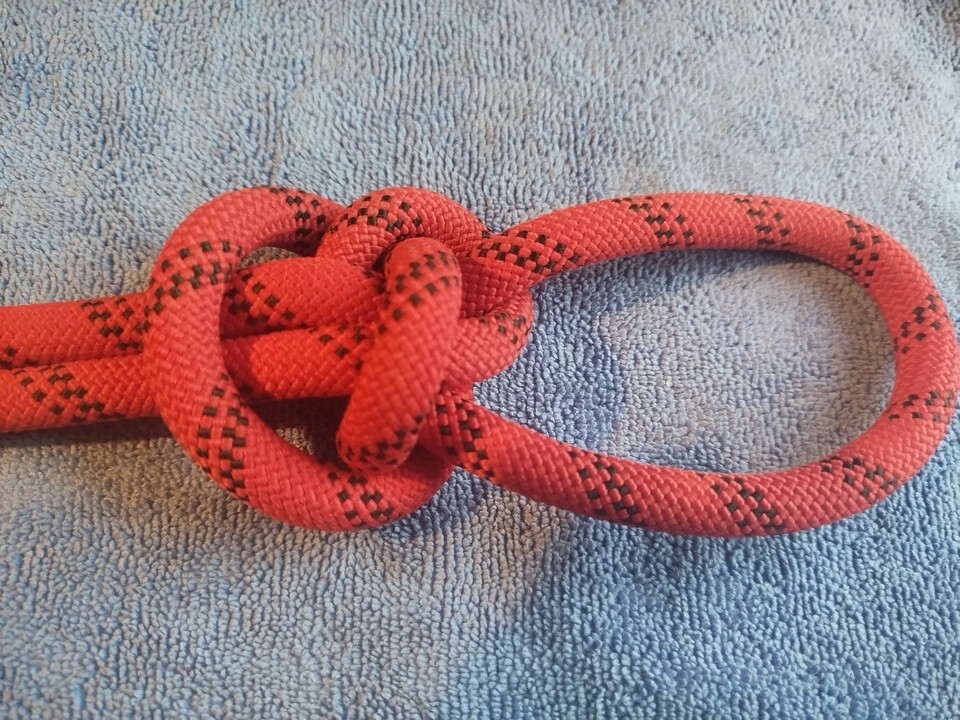
Referring again to your image in red rope of L'sLinkBwl
(noting, yes, my words come w/your graphic help!),
the parallel strands from the left you've used to feed
your (shouldn't be there) Larkshead
CROSS in the Tangle center --the upper strand
turns clockwise around the other and the lower
eye leg, and makes the broad collar;
while the other/lower strand crosses over the first
and turns anti-clockwise in making L'sLink Bwl
S.Part, flowing into the lower, and for LL'sB OELeg.
Here's a good way to help keep track of which
parts are where/whose, end-to-end ::
USE DIFF.colored ropes, with rope-red (say) taking
S.Part -> OELeg of Lee's Link Bwl (ends 1 &2 of strand
"1-2", and rope-white the completion, via strand A-B
(end-names in order of through-the-EK flow).
Then, of course, you will variously fuse opp-colored
ends to form the eye, their other ends one a S.Part,
one a Tail.
Lee's Link Bwl doesn't like being ring-loaded;
DblyHAH! seems to pretty well endure.
Both are NSExtremite ("TIB") --and indeed I really
canNOT tie DblyHAH! by reeving; it would take some
considerable practice so to form that non-knot
1-2 structure through which the "simplicity" of
a mere loop with the REL->Tail A-B part reeves.
Whereas Lee's Link Bwl well accommodates
tying in as though to a ring, and has its
complexity in the REL-Tail part where it's
most reassuring to not coming untied.
.
Dan needs to learn how to use a camera - or a cell phone with camera.
Using written words to describe a knot is convoluted.
Tangle center: Knot core? There is no 'tangle' - its has a specific geometric form.
Upper strand: Which way is up? And therefore, which way is 'down'?
Clockwise: Need a reference frame to define clockwise and anti clockwise
Lower: Which way is down?
Crosses over the first: Need to define 'up' and 'down' via some reference frame. Also, "over the first" which rope segment is 'first' in contrast to 'second' or 'third' - and then go 'over' it (assuming there is a defined up/down reference frame).
Curious: I always imagine an astronaut circling in orbit around the Earth. Using words as instructions to tie a knot, how would you define 'up', 'down', 'left', 'right', 'over', and 'under'?
...
I admire Mr 'Kost_greg's patience
I found some of my own instructions... (Warning, Australian humour)


 ), or anyone else interested , most suitable for this thread.
 )