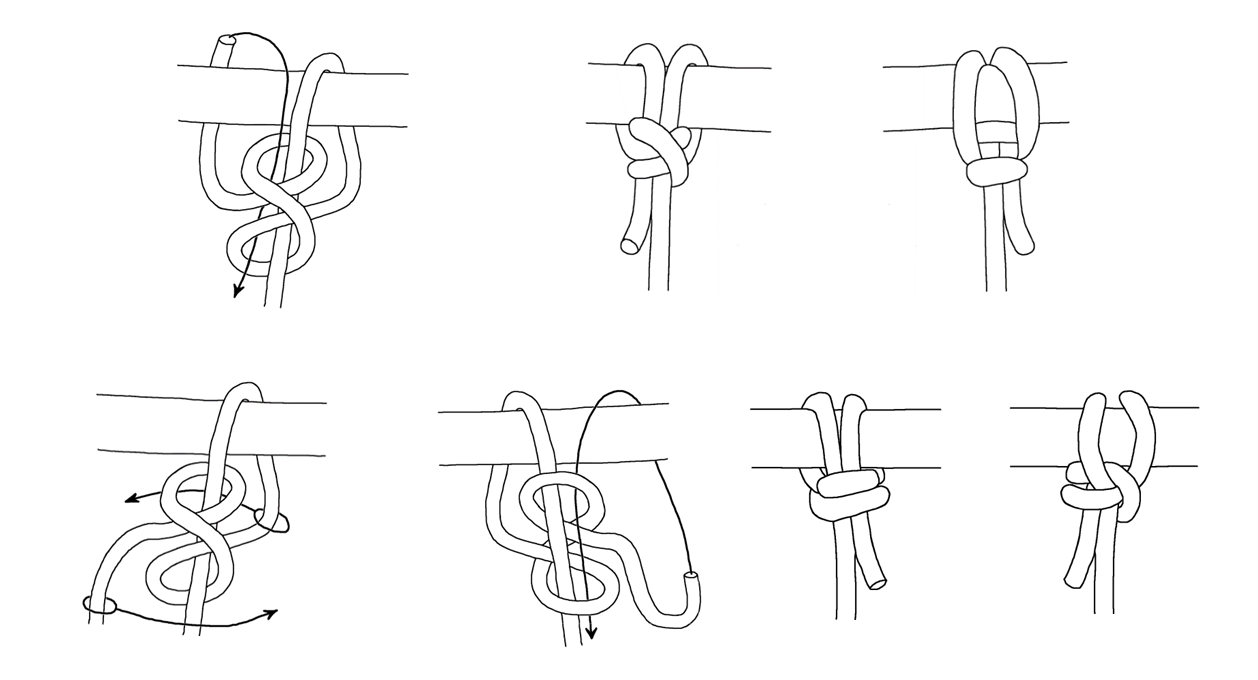
I had a need to fix several paracord loops along a larger rope, and the obvious first port of call was a girth hitch. Unfortunately when unloaded, it would quickly work loose, and the loop could slide or fall off.
I tried 2 turns, or 3 to make a Prusik, with not much better unloaded staying power. Variations of clove hitches and making the loop onto the rope were either complicated/tedious to tie, or used a lot of cord, or jammed after loading.
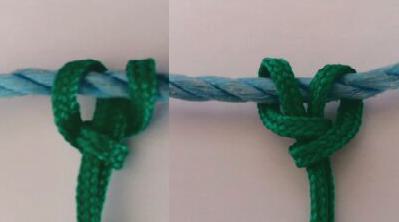
I eventually came up with this modification to a girth hitch, which I’ve not seen in the literature anywhere. Just enough extra friction to meet my requirements at the same time. It holds itself after tight cinching up. The straight tails through the round turn never jam. It’s simple to tie, the loop is pre-tied, and doesn’t use much cord.
I’ve tried several searches for variations of ‘girth hitch’, image searches, and a quick skim of likely parts of ABOK, but nothing has come up. I’m sure I haven’t invented this, so what’s it called, and why is it not better known?
Yes, it has made the current literature --I think that
book-a-year author Budworth has “Piwich Hitch”
along with (his naming?) “Bull H.” --stronger than
a Cow H., the point (surer holding, more than strength)
among names given to it.
Here’s a quick grab ::
The Bull Hitch (also called the Piwich Hitch) is a strong, versatile hitch knot used to securely attach a rope to a ring, post, spar, or similar object. It is a variant of the Cow Hitch but with an extra wrap that makes it more secure under tension.
Btw, I frequently use something akin to it, where the
wrapping is comparatively large. Halve (or “double”
–isn’t English great?! )
your binding line, bring the center of the U-fold around
to meet the two ends, which then are run through the
U-fold (aka “bight”, in ONE of its many senses) and around
one leg, then around the other (or the same --I like the
variety), and pull hard on the ends to cast those two
wraps-around-legs into the U-fold to yield a coil
–which grips the ends. Pull further, to tighten.
YMMV per materials & force needed to bind, but
it’s a genearlly nice way of making a quick binding.
For stability/lasting, you’ll need to tie off the two
ends; there are various ways to do this.
OK, note that MY regular use could be nitpicked as
using not the Bull Hitch variation of a Cow --treating
those hitches as single-S.Part with one Tail (unloaded),
and I load both --to set the knot–then tie off both;
so one might see “Cow” => “Larkshead”, though naming
is all over the place and often left imprecise.
There are also even more secure hitches. Two to consider are the Bull Clove Hitch (where the nipping structure is a Clove Hitch) and the Estar Hitch. These have been discussed long ago on this forum.
 )
)